
Let’s cut the crap right now: Michael Schumacher’s infamous Rascasse maneuver at the 2006 Monaco Grand Prix wasn’t a ‘misstep’ or some innocent error. It was a cold, calculated act of sabotage, a stain on his legacy that screams ‘win at all costs’ with every rev of the engine. This wasn’t a mistake.
This was a deliberate, cynical move by a man who would burn down the track to claim pole position.
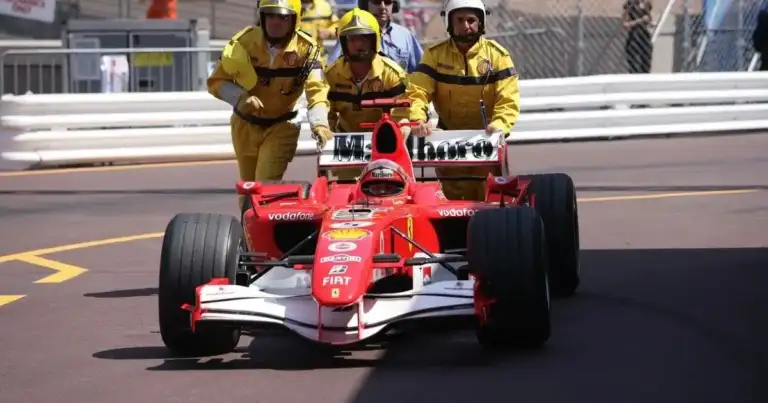
On May 27, 2006, during the dying seconds of qualifying, Schumacher’s Ferrari F248 didn’t just ‘stop dead.’ He parked that damn car with surgical precision, right in the tight Rascasse corner. This wasn’t bad luck; it was a blockade.
It choked the racing line, triggered those all-important yellow flags, and, just like he planned, utterly annihilated the final, crucial laps of his rivals. Pure genius, if you’re a cheat.
Schumacher, ever the master of plausible deniability, trotted out the old ‘wheel lock and stall’ excuse. But the FIA stewards weren’t born yesterday. After what I’m sure was a blistering interrogation, they didn’t just ‘rule’ he stopped his car; they declared he “stopped his car on the circuit in such a way as to hinder other drivers.”
Hinder? Try ‘deliberately screw over.’ The verdict was swift and brutal: stripped of all qualifying times.
Schumacher, the mighty champion, was relegated to the very back of the grid, starting the race from a humiliating 22nd position. Justice, served cold.
The Paddock’s Verdict: No Mistake Here
The paddock erupted. The reaction was swift, savage, and unanimous. Few, if any, swallowed Schumacher’s flimsy tale. Fernando Alonso, who was flying on a lightning-fast lap, didn’t just ‘not mince words’; he spat fire.
“It was very obvious what he did. Everyone saw it. I was on a very good lap, maybe pole position, and I lost it.”
— Fernando Alonso
Alonso’s fury was palpable. He didn’t just lose a chance at pole; he had it stolen.
Mark Webber, then a hungry Williams driver, didn’t just call it “pretty blatant”; he branded Schumacher a “repeat offender.” David Coulthard, never one to hold back, piled on, dismissing it as “typical Schumacher.”
The consensus wasn’t just “a deliberate, cynical tactic”; it was a damn conviction. The stewards’ ruling didn’t just ‘cement’ this view; it hammered it home like a final nail.
A History of Controversy
Let’s be brutally honest: the Rascasse incident wasn’t some isolated ‘anomaly.’ It wasn’t a one-off. It was a signature move, a classic Schumacher special.
This man didn’t just push boundaries; he smashed through them with a wrecking ball. His career isn’t just ‘littered’ with these moments; it’s practically defined by them, a reflection of his ‘win at all costs’ mantra etched in controversy.
- In 1994, he famously collided with Damon Hill in Australia, a maneuver that conveniently secured his first world championship. Coincidence? Don’t insult my intelligence.
- At the 1997 European Grand Prix in Jerez, he didn’t just ‘steer into’ Jacques Villeneuve; he tried to take him out. The FIA saw through it, disqualifying him from the entire 1997 championship standings. That’s not a slap on the wrist; that’s a public shaming.
- The 2002 Austrian Grand Prix saw Ferrari orchestrate the infamous team orders, forcing Rubens Barrichello to hand Schumacher a victory. It was so blatant, so unsportsmanlike, it led to a ban on team orders for years.
These aren’t just incidents; they’re bullet points on a rap sheet. They don’t just ‘paint a clear picture’; they scream it from the rooftops: Schumacher was ruthless, a predator who would twist, bend, or outright break the rules for an advantage.
Rascasse? Just another ugly masterpiece on that canvas of questionable ethics.
The Legacy Question: Dirty or Genius?
This incident didn’t just ‘shape’ Schumacher’s legacy; it tattooed ‘controversial’ across his forehead in his final years before his initial retirement. It didn’t just ‘reinforce’ the ‘win at all costs’ image; it cemented it as his brand.
For many, that ruthless, cutthroat competitive streak didn’t just ‘overshadow’ his raw driving brilliance; it *eclipsed* it. His undeniable skill? Absolutely there.
Driving from 22nd to 5th in that Monaco race? A goddamn masterclass, no doubt. But the stench of Rascasse meant even his triumphs were viewed through a cynical lens. People didn’t just ‘question’ the fairness of his methods; they outright condemned them.
Rascasse wasn’t just ‘a defining moment’ of his initial retirement era; it was the asterisk next to his name, ensuring his departure was forever shrouded in debate. It wasn’t just ‘legendary performance mixed with ethical questions’; it was a collision of glory and grime.
It didn’t just ‘fuel F1’s ongoing ethical discussions’; it threw gasoline on them. What is sportsmanship in this bloodsport? How effective are these damn rules when a legend openly flouts them?
These questions don’t just ‘haunt the sport’; they echo in every pit lane, every controversial decision to this day.
Monaco’s unique, claustrophobic layout isn’t just ‘a prime target’ for such tactics; it’s an open invitation. Qualifying isn’t ‘everything’ there; it’s life or death. Track position isn’t ‘paramount’; it’s the crown jewel.
Clear air isn’t ‘gold’; it’s pure oxygen in a suffocating race. Schumacher knew this. He didn’t just ‘exploit it’; he weaponized it.
The Unmasking: Excuses and Evidence
Schumacher, bless his heart, clung to his innocence like a drowning man to a life raft. He insisted it was a genuine mistake.
Ferrari team principal Jean Todt, ever the loyal soldier, backed him up. Technical director Ross Brawn, a man I usually respect, even tried to spin it as ‘driver error under pressure.’
But let’s be real: the evidence didn’t just ‘speak louder’; it roared. The reactions from his peers didn’t just ‘speak louder’; they screamed. And the stewards’ ruling? That didn’t just ‘speak loudest of all’; it dropped the hammer.
“The stewards concluded that Michael Schumacher deliberately stopped his car on the circuit in such a way as to hinder other drivers.”
— FIA Stewards’ Statement
Let me translate that for you: That’s not an accident. That’s a goddamn decision.
It’s the decision of a man who saw an opening, a loophole, and didn’t hesitate to drive a truck through it. He didn’t give a damn about the optics, the sportsmanship, or the cries of his rivals. He cared about one thing and one thing only: winning.
That’s the cold, brutal truth of motorsports at the highest level. The pursuit of victory isn’t just ‘ugly’; it’s a bloodsport where ethics often get sacrificed at the altar of the checkered flag. The Rascasse incident didn’t just ‘prove it’; it etched it into F1 history in neon lights.
Michael Schumacher was a titan, an absolute champion, a force of nature behind the wheel. But Monaco 2006 didn’t just ‘show the dark side of that drive’; it ripped off the mask.
It’s a stark, undeniable reminder that in the cutthroat, no-holds-barred arena of Formula 1, greatness and controversy aren’t just walking hand-in-hand; they’re locked in an eternal, uncomfortable embrace.
And sometimes, you have to ask: at what cost does legendary status truly come? Was it worth the stain?
Source: Google News