
Mercedes didn’t just stumble at the Hungarian Grand Prix; they face-planted, handing their rivals a championship gift and exposing a gaping, software-rotted wound that will absolutely derail their 2026 title bid if they don’t fix it, and fix it now.
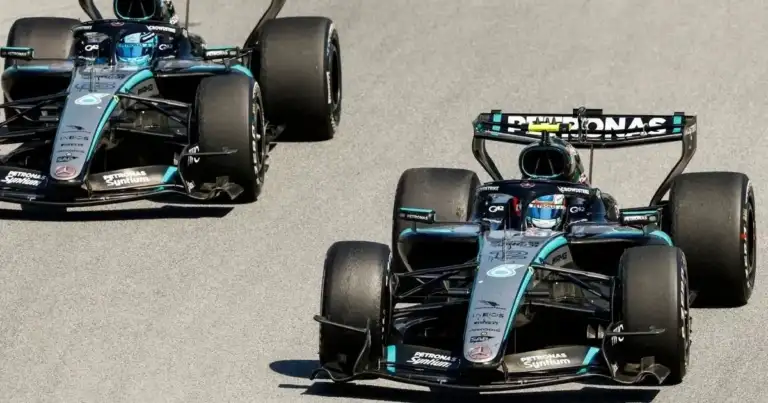
Team Principal Toto Wolff admitted a “complex software anomaly” gutted their race. It hit George Russell harder than rookie Kimi Antonelli. Russell finished a pathetic P7, while Antonelli scraped P9.
This wasn’t some minor hiccup; it was a full-blown, catastrophic systemic failure that cost them precious points. It leaves them a mere 15 points behind Red Bull in the Constructors’ standings and Russell a distant 22 points off the lead in the Drivers’ title.
The Glitch That Shook Mercedes to Its Core
The problems started early. Friday practice showed screaming telemetry and driver complaints.
Both Russell and Antonelli felt ghostly power surges and a total lack of grip. The cars were a bucking bronco, completely unpredictable.
Qualifying was a disaster. Russell crawled to P8, a shocking 0.7 seconds off pole. Antonelli was utterly lost at P11, 1.1 seconds back.
Engineers burned the midnight oil, tearing their hair out, but the damage was already baked in.
Race day? It was a damn crucifixion. Russell’s average race pace was a horrifying 0.5 seconds per lap slower than the leaders. Antonelli, while slower overall, managed his tires better, a small mercy in a sea of despair.
This isn’t just a ‘deeper issue’; this screams of a fundamental rot, far beyond a simple bad setup call.
“It was a complex software anomaly. It seems the way the car’s systems interacted with George’s driving style and setup amplified the negative effects far more than it did for Kimi. We need to understand exactly why and ensure it never happens again.”
— Toto Wolff, Mercedes Team Principal
Wolff’s words? They don’t just sting; they’re a public flogging. He didn’t just basically say it; he threw Russell under the bus, implying his driving style somehow triggered or exacerbated the problem.
That’s not just a brutal assessment for your supposed lead driver; it’s a vote of no confidence delivered with a cold, corporate smile.
It screams of a fundamental, terrifying disconnect between the car’s digital brain and the man strapped inside it. Who’s driving this thing, the computer or the human?
To lay blame, even subtly, on your star driver for a software malfunction is a desperate move. It undermines Russell’s confidence, and more importantly, it deflects from the very real engineering failure at the heart of the Mercedes operation.
This isn’t about driver preference; this is about a machine that refused to obey its commands.
Championship Hopes on the Line: A Dynasty Crumbles?
Will this derail Mercedes’ 2026 championship hopes? You’re damn right it will. Mercedes sits P2 in the Constructors’ standings, a mere 15 points behind Red Bull – a gap that feels like a chasm when your car is actively trying to kill you.
Russell is P3 in the Drivers’ title, a distant 22 points off the lead. This isn’t some minor setback; this is a championship-threatening catastrophe.
Margins in F1 aren’t just razor-thin; they’re microscopic, decided by fractions of a second and lines of code. One catastrophic weekend like Hungary doesn’t just swing momentum; it shatters it, sending the team spiraling.
A recurring software bug isn’t just ‘catastrophic’; it’s a death sentence for a championship campaign. This isn’t just about a single lost race; it’s about the erosion of trust, the pulverization of reliability, and the fundamental belief that your machine won’t betray you at 200 mph.
Mercedes forged its legendary dynasty on bulletproof reliability, on cars that ran like Swiss watches, not temperamental supercomputers.
This public admission of a gaping, fundamental flaw doesn’t just shatter that image; it obliterates it, leaving behind a smoking crater of doubt.
It paints a giant, flashing target on their backs. Rivals like Ferrari and especially Red Bull will not just exploit this weakness; they’ll carve it open and feast on Mercedes’ misery.
History is littered with teams that lost championships not due to pace, but due to chronic, unresolved reliability issues. Mercedes is now staring down that very abyss.
“The car felt unpredictable, especially in the high-speed corners. It was like driving with a mind of its own at times. It’s frustrating when you know you have more pace, but the car isn’t letting you extract it.”
— George Russell, Mercedes Driver
Russell’s frustration isn’t just palpable; it’s a raw, exposed nerve. How can any driver perform when the car is actively fighting him, when it feels possessed?
This isn’t merely a technical glitch; it’s a psychological war waged against your own driver.
Driver confidence doesn’t just erode fast; it evaporates in a puff of smoke when the very machine you trust with your life betrays you lap after agonizing lap. Russell needs a car he can trust, not a digital monster.
The Antonelli Angle: Rookie Resilience or Russell’s Weakness?
Kimi Antonelli’s performance might offer a sliver of hope, but it also screams volumes about Russell’s struggles. Antonelli, the rookie, adapted.
He still dragged that broken machine into the points. He showed the kind of grit under fire you expect from a seasoned veteran, not a fresh-faced rookie.
“It wasn’t easy, but we pushed through. Every lap is a learning experience, and even with the issues, I tried to find the limits.”
— Kimi Antonelli, Mercedes Driver
Wolff’s spin about Antonelli’s “adaptive approach” might have softened the PR blow, but let’s be real: the kid just drove around the problem better.
This kid is learning on the fly, showing up his more experienced teammate in the process. But what it really does is hammer home the brutal question: Is George Russell a fair-weather driver, utterly lost when the car isn’t singing perfectly? Is he too reliant on a flawless setup?
Software bugs aren’t just F1’s new unseen enemy; they’re the silent assassin lurking in the digital shadows. They’re a tangled, insidious mess of code.
Debugging them isn’t a weekend job; it takes weeks, sometimes months, of painstaking, soul-crushing work. There’s no magic bullet, no quick fix for a deep-seated digital flaw that’s infected the very core of your machine.
Antonelli’s relative success, despite the car’s issues, puts immense pressure on Russell. A rookie outperforming a seasoned driver, even under duress, raises uncomfortable questions about consistency and adaptability. Every young driver dreams of a debut like Antonelli’s, but for Russell, it’s a stark reminder that even with a multi-year contract, his position isn’t entirely unassailable if he can’t master a challenging car.
Pressure Mounts for Wolff: Defuse the Bomb or Watch It Explode
Toto Wolff isn’t just facing a ‘massive challenge’; he’s staring down a full-blown crisis, a potential career-defining meltdown. He needs to whip his technical team into a frenzy, demand answers, and crack some heads if necessary. They don’t just ‘must find a permanent solution’; they need to incinerate this bug, eradicate it from the system, and do it yesterday.
The upcoming races at Spa and Zandvoort aren’t just ‘important’; they’re a brutal gauntlet, tracks that will mercilessly expose any lingering deficiencies, demanding absolute precision and raw, unadulterated power. Any lingering deficiencies won’t just be exposed; they’ll be paraded naked for the entire world to see. This isn’t just about bleeding points; it’s about hemorrhaging credibility, about watching a dynasty crumble, about letting an entire championship slip through their fingers because of some botched lines of code.
Mercedes cannot, will not, survive another weekend like Hungary. Their championship hopes aren’t just ‘hanging by a thread’; they’re dangling by a frayed, single fiber over a pit of despair.
This software glitch isn’t just a ticking time bomb; it’s already detonating, tearing holes in their season. If Toto Wolff and his engineers don’t defuse this digital disaster now, Mercedes won’t just lose a championship; they’ll be remembered as the team that choked on a handful of faulty pixels. And trust me, The Finisher will be here to write their obituary.
Source: Google News