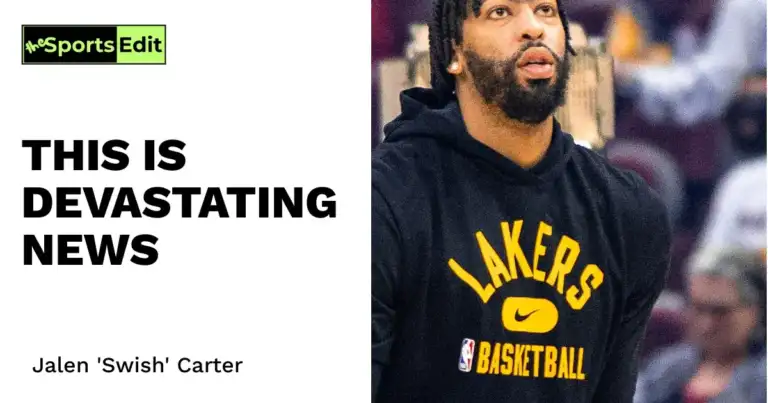

The Wizards’ grand plan for Anthony Davis has officially flatlined, leaving us all wondering if anyone in that front office actually believed this fairy tale. Just when you thought Washington couldn’t fumble the bag any harder, Davis’s hand injury now sidelines him through March, ensuring he still hasn’t touched the court in a Wizards jersey. This isn’t just bad luck; this is a full-blown organizational faceplant, a masterclass in how to pay a man millions to do absolutely nothing. The final score? An abysmal 0 games played for Davis, and a franchise left holding an empty bag.
The Ghost of Anthony Davis: A No-Show for the Ages
This whole “Anthony Davis to the Wizards” saga has been a comedy of errors from the jump. The team acquired Davis with all the fanfare of a blockbuster trade, hyping him as a cornerstone, a savior for a franchise that desperately needed one. And what have they gotten? A phantom. A rumor. A name on a roster sheet that hasn’t translated into a single minute of actual basketball. It’s a classic bait-and-switch, but the bait was injured before it even hit the water.
The latest intel, dropped like a brick on the hopes of Wizards fans everywhere, confirms Davis won’t return through March. That pushes his debut, if it even happens this season, further into the abyss. We’re talking about a “ligament issue” in his hand, a vague injury description that sounds more like an excuse than a diagnosis. Why the secrecy? What exactly is going on behind those closed medical doors? This isn’t some fringe player; this is Anthony Davis, a guy they were supposedly building around. The lack of transparency here is deafening.
“Anthony is working incredibly hard in his rehabilitation. We’re taking a very cautious approach to ensure he’s 100% healthy before he steps back on the court. His long-term health is our top priority.” — Wizards Head Coach (as reported by The Washington Post)
Spare me the boilerplate. “Long-term health” is always the priority when your investment is sitting on the bench, collecting checks. The cynics, and by that, I mean anyone with half a brain who follows the NBA, saw this coming a mile away. The whispers around the league were already loud, questioning whether the Wizards’ commitment to getting Davis and Young on the court was genuine. Turns out, the whispers were right. This isn’t caution; it’s a convenient narrative.
The Money Pit: Paying for Potential, Getting Purgatory
This isn’t just about disappointment; it’s about cold, hard cash. The Wizards are shelling out serious dough for Davis, money that could be going to actual players contributing on the court. While specific salary figures for the *upcoming* 2025-2026 season aren’t plastered across every news report about his injury, let’s not pretend this is a bargain bin acquisition. This is a substantial investment for a player who, so far, has delivered precisely zero return. His current contract, reportedly around $35 million for the season, is a dead weight on the books.
Think about the salary cap implications. Every dollar tied up in an injured, non-playing star is a dollar that can’t be used to acquire talent, fill roster gaps, or build chemistry. The Wizards are already a bottom-feeder, with a win-loss record that’s more embarrassing than a flopping guard trying to draw a foul in a blowout. Losing Davis, a player meant to elevate them, just digs that hole deeper. It’s a financial black hole, sucking up resources without any light at the end of the tunnel. This isn’t just a bad trade; it’s a cap catastrophe.
- Zero Games Played: Davis has yet to make his Wizards debut.
- Prolonged Absence: Sidelined through March, pushing potential return to April at the earliest, if at all.
- Vague Injury: “Ligament issue” in the hand, lacking specific details, raising eyebrows across the league.
So, who benefits here? Not the Wizards. Not the fans. Not even Davis himself, who has to be stewing on the sidelines. The only beneficiaries are the opposing teams who get to feast on a Wizards squad devoid of its supposed star power. It’s a sad state of affairs when your most valuable asset is a placeholder on the injury report.
The “Process” Revisited: Are the Wizards Just Tanking with Style?
This entire situation reeks of a front office trying to spin a losing season into a narrative of “patience” and “long-term vision.” But here’s the real question—is this truly about player health, or is it a convenient excuse to further their tanking agenda? The Philadelphia 76ers mastered the art of the “Process,” using injuries to high draft picks like Joel Embiid and Ben Simmons as a shield for their deliberate losing. Are the Wizards taking a page from that playbook, but with a veteran acquisition instead of a draft pick? It certainly looks like it from my vantage point.
It’s a cynical take, I know, but look at the track record. A struggling team acquires a significant player, and suddenly, he’s out indefinitely with an injury that lacks transparent details. It allows them to continue losing, secure a high draft pick, and then trot out the “he’ll be back stronger next year” line. Does anyone actually believe that the Wizards, a team in desperate need of a spark, are simply being *overly* cautious? Or are they just managing assets in a way that maximizes their draft lottery odds? The silence around Davis’s precise condition speaks volumes.
The public reaction, what little there is beyond a collective shrug of resignation, suggests a deep skepticism. Fans have been burned too many times. When management says one thing and the outcome is consistently another, you start to question the entire operation. This isn’t just a player injury; it’s a symptom of a franchise struggling to find its footing, resorting to vague updates and prolonged absences. The Wizards are playing a dangerous game, testing the patience of an already beleaguered fanbase.
The Anthony Davis saga is a stark reminder that in the NBA, sometimes the biggest stories aren’t about the highlights, but about the balance sheets and the strategic silences. The Wizards are paying for a ghost, and the fans are left to wonder if he’ll ever materialize. Or perhaps, more accurately, if the front office even wants him to.
Source: Google News