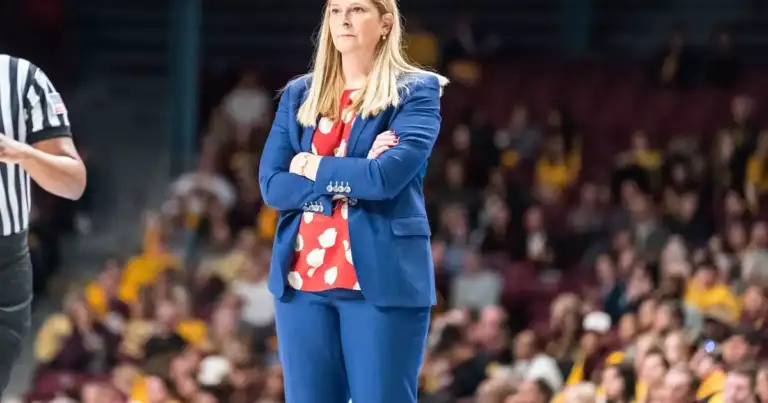

A college basketball coach raises her voice, and suddenly the sky is falling. Maryland’s Brenda Frese, a titan of the hardwood, found herself ensnared in manufactured outrage, not for a championship run, but for a “fierce backlash” over coaching her player, Oluchi Okananwa, during March Madness.
This isn’t just a tired song and dance; it’s a lamentable misunderstanding of competitive sport. The final score of that game, a nail-biting 64-61 victory for Maryland over Iowa State, only underscores the pressure cooker environment in which Frese operates and excels.
The incident itself, a fleeting sideline exchange, went viral. Many, from their comfortable armchairs, were quick to label it “aggressive,” mistaking intensity for malice. Yet, the true narrative paints a far more nuanced picture.
Okananwa, far from being a victim, emerged from the exchange invigorated, scoring crucial buckets and making key steals that propelled her team to victory. Her stat line for the game, a robust 12 points, 7 rebounds, and 3 assists, speaks volumes about her resilience and the effectiveness of her coach’s methods.
The Player’s Echo: “I Love Being Coached Hard!”
The inconvenient truth that shatters the fragile edifice of manufactured outrage: the player in question, Oluchi Okananwa, not only defended Frese but embraced the very intensity that sent social media into a frenzy. She declared, unequivocally, that she “loves being coached hard every single day.”
This isn’t some meek acceptance; it’s the roar of a “competitor at heart” who understood Frese’s message not as an attack, but as a challenge. Great coaches, the architects of champions, don’t coddle; they push.
They demand more, not less. The proof, as they say, is in the pudding. After that intense exchange, Okananwa didn’t wilt; she blossomed. Even Jomboy, the astute sports breakdown analyst, saw through the digital fog, calling it “just a little coaching” and concluding that it was “all that was needed.”
The Double Standard: When Passion Becomes “Abuse”
Why then, the instant leap to “fierce backlash” and the expectation of groveling apologies? It’s simple, and frankly, it’s infuriating. It fits a narrative, a tired, predictable script that often misunderstands the raw, visceral nature of competitive sports, especially when a woman dares to lead with the same fire as her male counterparts.
When legendary male coaches like Geno Auriemma or the late, great Pat Summitt raised their voices, it was lauded as passion. But when a woman coach does it, suddenly it’s “abuse,” a transgression against some unwritten, gendered code of conduct. This isn’t just a double standard; it’s an insult.
This isn’t a new phenomenon; it’s a recurring pattern. People, often those far removed from the sweat and grit of the arena, eagerly jump on any decontextualized clip, twisting it, manipulating it, and fabricating a “scandal” where none exists. It’s a convenient way to generate clicks and engagement, sacrificing nuance and truth at the altar of viral content.
The Real Corruption: Beyond a Sideline Yell
This whole charade, this moral panic over a coach coaching, starkly contrasts with the very real, often overlooked, issues plaguing college athletics. We see coaches yelling all the time in the college football industrial complex, yet the true outrage should be directed elsewhere.
It should be aimed squarely at the unholy trinity of money, power, and corruption that defines so much of modern college sports. Think about the seismic shifts brought by Name, Image, and Likeness (NIL) deals, the chaotic free-for-all of the transfer portal, and the relentless pursuit of television money that often overshadows athlete welfare.
These are the genuine crises. Coaches today are under immense pressure, navigating a minefield of agents, booster collectives, and the constant threat of player departures. They face accusations of tampering, manage multi-million dollar budgets, and are expected to deliver championships all while maintaining academic integrity.
Where is the “fierce backlash” for a system that increasingly exploits young athletes, turning them into commodities? Where is the outrage for conferences that chase TV revenue with an almost religious fervor, or for a playoff committee that, year after year, seems to tip the scales in favor of the SEC? These are the systemic failures that truly threaten the integrity of college athletics, not a coach inspiring her player to greatness.
The Illusion of “Apologies” and the Media’s Role
Let’s be clear: there’s a chasm between real backlash and manufactured outrage. Real backlash erupts when coaches break rules, abuse players, or violate ethical standards. But this? This was a coach, coaching.
The very idea of Frese issuing a “fierce apology” for doing her job is absurd. She didn’t need to grovel; she needed to explain, to clarify the “tough conversations” built on a foundation of trust. That trust is the bedrock of any successful coach-player relationship.
The media, in its relentless pursuit of clicks and controversy, plays a colossal role in manufacturing these pseudo-scandals. They sensationalize, amplify, and craft narratives that sell. This incident is a textbook example: take a small, decontextualized moment, blow it up, label it a “fierce backlash,” and then sit back as the outrage machine churns.
It’s lazy journalism, a distraction from the real stories: the seismic shifts in college athletics, the complex issues of player welfare, and the challenges of ethical leadership in an increasingly commercialized landscape.
The Enduring Power of Tough Coaching
Great coaching, the kind that forges champions, is not about being universally liked; it’s about extracting the absolute best from every player. Sometimes that demands tough love. Sometimes it means holding players accountable. Sometimes, it means a loud voice, a pointed critique, a demand for more.
This isn’t a novel concept; it’s a timeless truth understood by legends across all sports, from the stoic wisdom of Bear Bryant to the fiery intensity of Bill Belichick, from the strategic genius of Mike Krzyzewski to the unwavering resolve of Pat Summitt. They all understood that intensity, properly channeled, breeds success.
This incident, this tempest in a digital teapot, is a microcosm of a larger societal trend: the constant scrutiny, the instant judgment, the desire to sanitize every aspect of human endeavor, especially sports. But college sports are not sterile; they are vibrant, emotional, and raw.
They are full of passion, drama, and the messy, beautiful reality of human competition. Let coaches coach. Let players play. And let us, as observers, reserve our “fierce backlash” for the genuine problems plaguing college athletics – the systemic issues that erode the integrity of the game, not the moments that inspire greatness.
Photo: Photo by Lorie Shaull on Openverse (wikimedia) (https://commons.wikimedia.org/w/index.php?curid=87619704)
Source: Google News