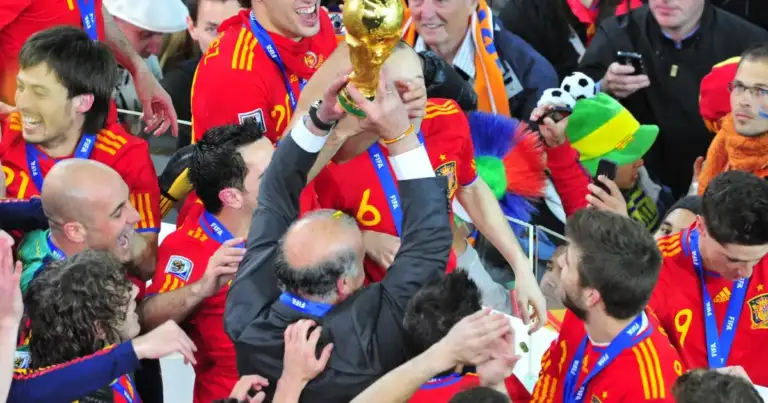

The roar of MetLife Stadium on Sunday, July 19, 2026, will echo through eternity. Spain, with a single, brutal strike in the 108th minute from their midfield general Rodri, didn’t just win a football match; they seized their second World Cup title from Argentina, carving their name into the very bedrock of footballing immortality. This wasn’t merely a victory; it was a coronation, a seismic shift in the global game that ended in a dramatic 1-0 overtime thriller.
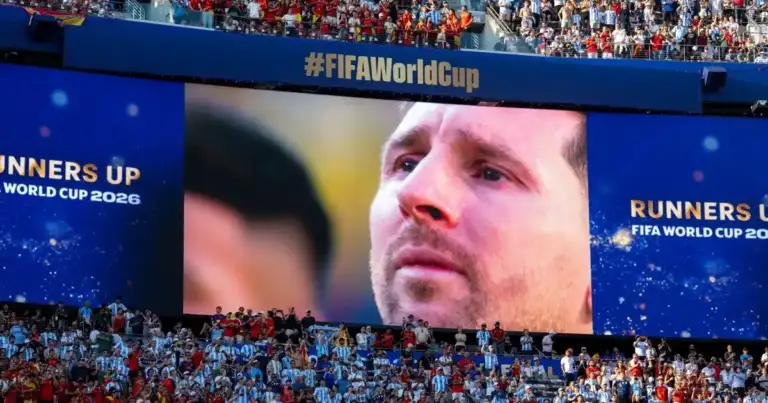
For 90 grueling minutes, this World Cup final was a tactical masterpiece of suffocation, a brutal chess match that remained deadlocked at 0-0. Spain, with their mesmerizing 62% possession, didn’t just control the ball; they choked the life out of every Argentine foray, turning the Albiceleste’s attacking dreams into dust. For Lionel Messi, the maestro, and his heartbroken nation, it was a torment writ large across the emerald pitch.
Spain’s Golden Era Arrives
This Spanish squad, a potent elixir of grizzled veterans and audacious youngsters, didn’t just win; they conquered. Coach Luis de la Fuente, a quiet genius, didn’t merely blend experience with raw, dynamic talent; he forged an unbreakable, crimson machine. Forget the past; the future of football, undeniably, irrevocably, wears the fiery red of Spain.
From the sun-drenched pitches of La Masia to the colossal stage of a World Cup final, players like Pedri and Gavi didn’t just control the midfield; they owned it, weaving a suffocating tapestry of passes that left Argentina chasing shadows. And then there was Lamine Yamal, a prodigy barely out of his teens, whose dizzying bursts of genius will undoubtedly plague the nightmares of fullbacks for a generation. Spain’s famed tiki-taka, evolved and sharpened, became an impenetrable fortress, an elegant weapon against which Argentina had no answer.
But it was in the crucible of extra time that Spain delivered the fatal blow. A lightning-fast one-two exchange ripped open the Argentine right flank. Dani Olmo, with the vision of a surgeon, threaded the ball to Rodri. From outside the box, the midfielder unleashed a low, venomous strike that arrowed past a despairing Emiliano Martínez, detonating an explosion of crimson joy across MetLife. This wasn’t just a goal; it was a manifesto – a testament to the patience, precision, and unwavering belief that defines this Spanish generation.
With this triumph, Spain hasn’t merely joined an elite club; they have forcibly entered the pantheon of footballing giants, planting their flag firmly among the multi-World Cup winners. Beyond the estimated $42 million in prize money – a mere trifle compared to the glory – this victory will send an electric current through the Spanish soul, igniting an economic boom, a surge in tourism, and a national pride that will burn brighter than the summer sun.
Messi’s Agonizing Farewell
But for Argentina, the pain of this defeat will fester, a wound that will sting for generations. The dream of back-to-back titles, a feat untouched since Pelé’s Brazil in 1962, was brutally extinguished. Far more devastating, however, was the crushing reality that this was almost certainly Lionel Messi’s final, agonizing dance on the World Cup stage.
Messi, the eternal magician, fought with every fiber of his being, a solitary star against a constellation. But Spain’s defense was not merely a wall; it was a granite fortress, impenetrable, unyielding. His exquisite free-kick in the 80th minute, a tantalizing arc that kissed the crossbar, was a cruel, mocking whisper of destiny unfulfilled. The frustration, the sheer, unbearable weight of it all, finally erupted, earning him a yellow card in the 115th minute – a desperate, almost symbolic lunge at Pedri, a final act of defiance against the inevitable.
Argentina, for all its individual genius, particularly from its captain, simply could not match Spain’s collective symphony. Their mere 2 shots on target, dwarfed by Spain’s 5, tell a stark story of creative impotence. The dream of a fourth star, a crowning glory for a football-obsessed nation, was not merely lost; it was torn away in extra time by a team that was, quite frankly, superior in every conceivable facet.
The Future of Football
The global football landscape has been irrevocably altered. What we witnessed was not merely a victory, but a profound changing of the guard, a continental shift in power. Spain has not just arrived; they have stormed the gates, not as a fleeting comet, but as a blazing sun, ready to cast its long shadow over the sport. This young, ravenous squad possesses not only the breathtaking talent but also the steely mentality to forge a dynasty that could rival any in history.
The Dynasty Beckons for Spain
With a core of players like Pedri, Gavi, Yamal, and Rodri still in their prime or yet to reach it, the potential for sustained dominance is terrifyingly real for their rivals. De la Fuente has crafted a team that blends tactical discipline with an almost artistic flair, a combination that is exceedingly rare. Will we see them lift the trophy again in four years? The early signs suggest it would be foolish to bet against them.
Argentina’s Reckoning Without Messi
But what of Argentina? The question hangs heavy, a shroud over their future: how does a nation move forward, how does it even breathe, without its celestial captain, Lionel Messi? The weight on Lionel Scaloni’s shoulders will be monumental, an Everest of expectation. They face not just a rebuild, but an existential quest to unearth new leaders, to forge an identity, and to somehow, impossibly, discover a path forward without the greatest player to ever grace their red and white stripes.
This World Cup final was not just a game; it was a visceral, brutal opera, a breathtaking testament to the razor-thin margins of high-stakes football. Spain, with their surgical precision and the fearless abandon of youth, demonstrated unequivocally that tactical mastery and collective spirit can indeed conquer all. As the sangria flows like rivers through Madrid’s jubilant streets for weeks to come, a profound silence will fall upon Buenos Aires, a city plunged into mourning for a legend’s final, unfulfilled World Cup dream. The torch has been passed. The world waits to see who dares to challenge Spain’s reign.
Source: Google News