
The final whistle blew on the 2026 FIFA World Cup, but for two towering figures, the reverberations of failure were deafening. FIFA President Gianni Infantino and Uruguay’s enigmatic manager, Marcelo Bielsa, didn’t just stumble; they plummeted, earning a resounding ‘F’ grade from a world watching in disbelief. What should have been a glorious celebration of football was instead marred by their colossal missteps, leaving a bitter taste in the mouths of fans globally.
Uruguay’s ignominious early exit from the Group Stage on July 19, 2026, didn’t just seal Bielsa’s fate; it shattered a nation’s dreams. This was a squad brimming with world-class talent, yet they limped out of Group H with a paltry one draw and two soul-crushing losses. Finishing dead last with a single point was an unforgivable capitulation for a footballing powerhouse like Uruguay.
Bielsa’s Tactical Enigma
The final, gut-wrenching blow arrived with a shocking 1-0 defeat to Saudi Arabia – a team Uruguay should have swatted aside. Bielsa’s men boasted an astonishing 65% possession, yet produced a pathetic two shots on target. Two shots in a World Cup decider was unbelievable, an indictment of a tactical approach that strangled creativity.
The decisive Saudi goal, a dagger to the heart in the 78th minute, was a textbook counter-attack that exposed Bielsa’s notoriously high defensive line, leaving them utterly flat-footed. This wasn’t merely an early exit; it was a catastrophic failure, an affront to the proud footballing heritage of Uruguay.
“Uruguay’s performance was a tactical enigma. Bielsa’s unwavering approach, which can be his greatest strength, proved to be his undoing against teams that simply sat deep and absorbed pressure.” – ESPN pundit, July 20, 2026.
Ever the stoic, Bielsa himself accepted the poisoned chalice of blame. “We came here with ambition, and we leave with regret,” he murmured, his voice heavy with defeat. “The responsibility is mine. I could not find the solutions.” But for a man so dedicated to his philosophy, was “could not” truly an admission, or a stubborn refusal to adapt?
Infantino’s FIFA Fiasco
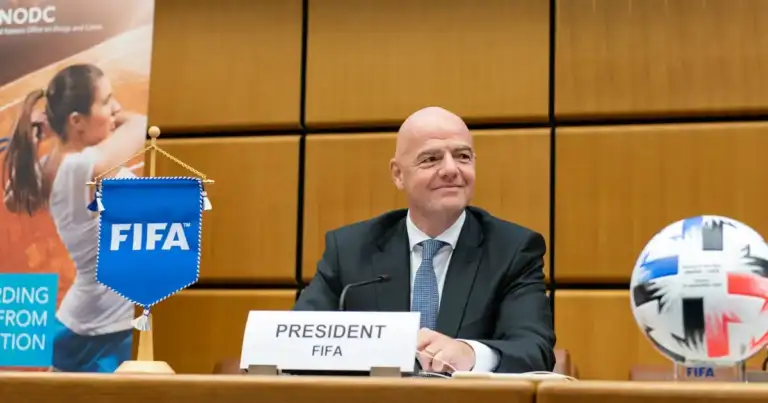
Meanwhile, far from the pitch, Gianni Infantino’s FIFA was engulfed in a maelstrom of its own making. The “F” grade didn’t just trickle in; it cascaded, a torrent of condemnation flooding headlines on July 20th and 21st. This wasn’t just criticism; it was a damning, undeniable indictment of an organization that seemingly forgot how to run the world’s biggest sporting spectacle.
The much-touted new semi-automated offside technology was an unmitigated disaster. Instead of clarity, it delivered endless, agonizingly controversial VAR reviews that choked the life out of crucial knockout matches. Ninety seconds on average for a decision meant players stood around, fans fumed, and the beautiful game was held hostage by a screen.
Fans and players alike were left in a purgatory of frustration, watching precious minutes bleed away. The very pulse of the game was constantly interrupted, its rhythm shattered. Even after these interminable delays, the decisions remained as contentious and infuriating as ever.
“The VAR system was supposed to clarify, but it only added to the confusion and frustration. The constant stoppages, the lengthy reviews – it felt like the game was being played in slow motion at times. This is on FIFA, and ultimately, on Infantino.” – The Guardian sports columnist, July 21, 2026.
Beyond the pitch, the logistical failures were nothing short of scandalous. Host stadiums became arenas of chaos, and public transportation was a nightmare, spawning endless queues. Concession stands ran dry of food and drinks during matches, a fundamental breakdown in basic event management.
And let’s not forget the persistent, pungent whiff of financial opacity. The expanded 48-team format wasn’t about more football; it was a transparent, cynical cash grab. Player welfare and fan experience were sacrificed on the altar of the bottom line, reduced to mere footnotes in FIFA’s ledger.
What Now for Bielsa?
For Marcelo Bielsa, ‘El Loco,’ the immediate fallout is a career-defining crisis. His job doesn’t just hang by a thread; it dangles precariously over a precipice. Will he, the proud architect of his own destiny, resign, or will the AUF deliver the ignominious axe? The pressure isn’t just immense; it’s suffocating.
He penned a two-year contract with the Uruguayan Football Association (AUF) in May 2025, a deal meant to guide them through to the 2027 Copa América. But in the brutal world of international football, a contract is merely a scrap of paper when the results are this spectacularly catastrophic.
Bielsa, ever the maverick, possesses a notorious history of walking away when his vision clashes with reality, or when things simply go south. Remember Lazio in 2016? He famously resigned just two days after his appointment! His principles, his unyielding philosophy, are sacrosanct; they trump any contractual obligation or public expectation.
Reports from local Uruguayan media on July 20-21 paint a vivid picture: the AUF board is locked in emergency meetings, discussing the team’s future leadership. Public opinion, a roaring tempest, is decisive, with a staggering 80% of fans baying for a change. Can any manager survive such a tidal wave of discontent?
Bielsa, in his characteristic manner, shouldered the blame, yet offered no hint of his future plans – a silence that speaks volumes. This leaves the door not just open, but gaping. My money is on the man who always chooses his own path
Photo: Wikimedia Commons (query: Marcelo Bielsa)
Source: Google News