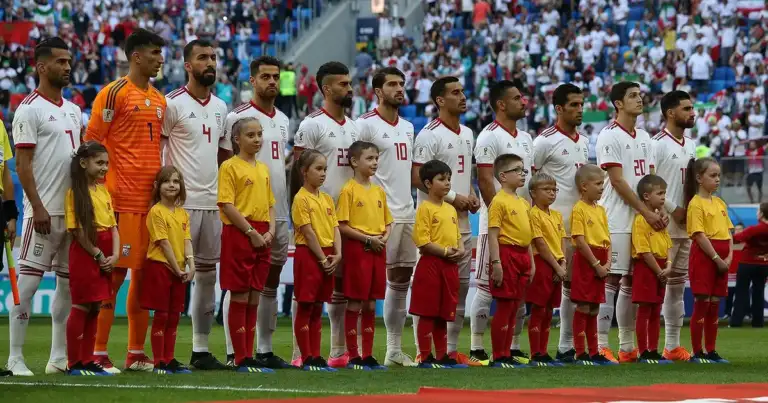

In a move shrouded in geopolitical tension and military-grade secrecy, Iran’s national soccer team executed a clandestine arrival in Los Angeles, touching down a full day ahead of schedule and vanishing into a fortified Beverly Hills hotel. This isn’t merely a football team arriving; it’s a stark, visceral demonstration that the beautiful game itself has become a battleground in a world on edge.
Team Melli, Iran’s footballing standard-bearers, didn’t just arrive; they descended upon LAX on Friday, June 12th, 2026. This wasn’t a simple flight; it was a ghost maneuver, a full 24 hours before their publicly declared landing.
Local authorities, caught somewhat off guard, confirmed the clandestine operation. This was a clear, audacious tactical play by the Iranian Football Federation, one steeped in a far more dangerous game than mere sport.
From the tarmac, a phalanx of grim, unyielding security personnel whisked the team into the heart of Beverly Hills. Their designated hotel isn’t just secure; it’s a veritable fortress, an impenetrable citadel in the opulent landscape.
Imagine a **multi-block perimeter**, crawling with **LAPD officers**, **federal agents**, and **private contractors**. The menacing presence of **K9 units** and the silent, watchful eyes of **drones** circle overhead.
Access isn’t merely restricted; it’s locked down. A maze of checkpoints and armed guards has turned a luxury haven into a high-stakes military operation.
Why the Iron Curtain? Politics on the Pitch
Why this unprecedented show of force? Why the cloak-and-dagger arrival that would make a spy thriller blush?
The answer, tragically, is brutally simple: the United States and Iran are not merely engaged in “complex relations”; they are locked in an active, declared state of war. The Reality Ledger, stark and unforgiving, confirms military strikes commenced on **February 28, 2026**.
This isn’t diplomatic posturing; this is ongoing, armed conflict. It casts a long, dark shadow over every kick of the ball.
In this volatile climate, any Iranian presence on U.S. soil is not merely a security headache; it’s a geopolitical minefield. The Iranian team, despite their athletic prowess, are irrevocably seen as potent symbols of the Iranian state.
They are not just players; they are lightning rods, magnets for fervent protests and chilling threats, caught between the roar of the crowd and the rumble of distant war.
Lest we forget the recent past, the 2022 World Cup in Qatar offered a chilling preview. Team Melli’s matches there weren’t just games; they morphed into raw, emotional protest zones.
The vibrant Iranian diaspora and courageous human rights activists seized every moment, every global spotlight, to amplify the cries against domestic unrest. The players themselves were caught in an agonizing pressure cooker, facing unimaginable pressure.
Some even made the brave, defiant choice to refuse to sing their national anthem. What torment must that have been?
These young men, these athletes, are tragically caught in the crossfire. They bear the heavy mantle of representing their nation, yet many also grapple with the profound moral imperative to speak out against injustice.
This isn’t just vulnerability; it’s an existential dilemma that screams for protection. As a host nation, the U.S. has an absolute, non-negotiable duty to guarantee their safety.
This duty exists not just because FIFA demands it, but because basic human decency demands it, regardless of the tempestuous political climate.
Voices from the Front Line
The security measures are unprecedented. They highlight the impossible tightrope walk for everyone involved. A sanitized, bureaucratic statement, perhaps, but one that barely scratches the surface of the unprecedented reality unfolding:
“Our priority is the safety and security of all teams and the public. The measures in place are robust and are the result of extensive collaboration between local and federal agencies, proportionate to the assessed threat landscape.”
– LAPD Spokesperson, Los Angeles Times, June 14, 2026
But not everyone sees it that way. Iranian-American community activists feel silenced, their voices muffled by the very security meant to protect:
“This level of security, while understandable from a safety perspective, effectively creates a barrier between the team and the Iranian diaspora who wish to express their solidarity with human rights movements in Iran. It feels like our voices are being locked out.”
– Roxana Mohammadi, Iranian-American Community Activist, The Guardian, June 15, 2026
Her words cut deep, exposing the painful paradox of security measures that inadvertently silence the very voices they might claim to protect. Is this truly safety, or merely another form of political control?
The players? They just want to play. Or at least, that’s the official, carefully crafted line from the federation:
“We are here to play football. Our focus is entirely on the tournament and representing our nation on the field. The federation handles all logistical and security arrangements to ensure we can concentrate on our sport.”
– Unnamed Iranian Football Federation Official, via Reuters, June 14, 2026
The Cost of “Neutrality”
FIFA, in its gilded ivory tower, perpetually preaches that sports transcend politics. What a breathtakingly naive, utterly cynical load of rubbish!
This unfolding saga in Los Angeles doesn’t just prove it; it screams it from the rooftops. The 2026 World Cup isn’t merely becoming a political battleground; it has already been declared one, long before the first whistle blows.
And what of the financial toll? The cost of these “insane security measures” isn’t just staggering; it’s an astronomical burden.
Taxpayers, American citizens, are now footing the colossal bill to protect a team from a nation with whom their own country is in active, bloody conflict. This isn’t merely the price of hosting a global event; it’s the steep, bitter cost of attempting to stage a party when the world is quite literally on fire.
But the heaviest cost falls upon the players themselves. Imagine the profound mental challenge: locked down, isolated from the outside world, their every movement scrutinized.
All this happens while the specter of war rages in their homeland. How can any athlete perform at their peak under such suffocating conditions?
This isn’t just a mental game; it’s a profound trauma. They are athletes, yes, but they are also unwitting, unwilling pawns in a geopolitical chess match far grander and more dangerous than any football tournament.
This isn’t about the purity of fair play or the idealism of sportsmanship. This is about raw control, the brutal calculus of national pride, and the relentless pursuit of geopolitical leverage. The World Cup, once hailed as a beacon of global unity, has been irrevocably transformed. It now stands as a high-stakes, heavily guarded diplomatic summit, thinly disguised by the veneer of a football tournament. The illusion is shattered. Don’t dare expect politics to stay off the pitch; it’s not just running the show, it is the show, and its shadow will loom large over every goal, every victory, and every agonizing defeat in this most politically charged of World Cups.
Photo: Wikimedia Commons (query: Iran soccer)
Source: Google News