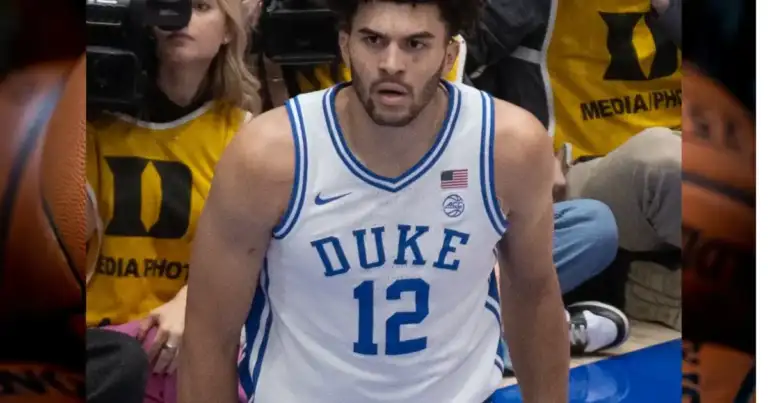

Duke’s freshman phenom, Cameron Boozer, sustained multiple facial fractures during the Elite Eight loss to UConn on Saturday, April 4th, 2026. This isn’t just another injury report; it’s a harsh reality check on the brutal physicality of the game and a lightning rod for immediate, widespread cynicism from fans who question everything from player safety to the very narrative being spun.
Boozer, a pivotal force for the Blue Devils, collided with UConn forward Alex Karaban while battling for a rebound under the basket. The impact was immediate and severe: Boozer clutched his face, exiting the game and never returning. Duke ultimately fell to UConn 78-73, ending their championship aspirations. The Duke athletic department confirmed the devastating injury on April 5th, stating Boozer would require surgery and faces an unknown recovery timeline, a development that undoubtedly casts a long shadow over his sophomore season and future draft prospects.
The Hardwood’s Unforgiving Truth
Let’s be unequivocally clear: this isn’t a twisted ankle or a minor sprain. We’re talking multiple facial fractures. This is a visceral, painful reminder of the immense physical toll these young athletes endure. They lay their bodies on the line for our entertainment, for the glory of their schools, and for the NCAA’s multi-billion-dollar empire. Yet, when the crunch comes, it’s their bones, their faces, their futures that bear the brunt.
The game’s outcome ended Duke’s season, but Boozer’s injury could derail his immediate future, potentially impacting his NBA draft stock. This is the human cost, a narrative far more complex and poignant than any final score could convey. How can we, as fans and analysts, reconcile the thrill of competition with the potential for such life-altering injuries?
The Public’s Cynical Verdict
While Duke’s official statement is straightforward, the court of public opinion is anything but. Social media platforms are ablaze with conspiracy theories, with many fans dismissing the injury as a “PR masterclass.” The prevailing sentiment? That this injury, and its subsequent announcement, is strategically timed to manipulate Boozer’s NBA draft narrative.
“Fractures around the eye? Perfect timing for a top-5 pick to play victim and skip surgery pre-draft. Duke PR masterclass.”
This Reddit comment encapsulates the deep-seated distrust permeating the fanbase. There’s a widespread belief that Duke, a program often perceived as meticulously managed, is orchestrating a narrative for Boozer’s benefit. The sight of Boozer on the bench, receiving what many derisively termed the “cold soda can” treatment, only fueled the fire. “What, no ice pack? This is WWE, not NCAA,” one X user quipped. This isn’t just about skepticism; it’s the raw, unvarnished cynicism born from years of perceived NCAA exploitation and carefully crafted media narratives.
Is Boozer’s Injury a Calculated Pity Play?
Why such a harsh, immediate backlash? The Boozer twins, Cameron and Cayden, sons of former NBA star Carlos Boozer, have long faced intense scrutiny, often seen as privileged. Cayden’s earlier turnover even drew death threats. Now, Cameron’s injury, tragically, shifts the spotlight, potentially crafting a “poor babies enduring social media hell” narrative. Is it fair? Perhaps not, but the public’s perception is a powerful force.
X users are not holding back, labeling the situation “performance art” and suggesting it’s “engineered for sympathy votes.” This all unfolds as UConn advances, leaving many to wonder if the injury announcement is simply a distraction. It’s a brutal assessment, yet it reflects a public weary of what they see as manufactured narratives in the high-stakes world of college sports. Skeptics are demanding specifics: “Multiple fractures but ‘I’m all good’? No specifics, no pics, just vibes.” The lack of granular detail only exacerbates suspicion, leading to accusations that NBA scouts are “eating this hero arc up.” This isn’t merely about an injury; it’s a profound commentary on perception, public relations, and the cold, hard business of college basketball.
The NCAA’s Deafening Silence on Player Safety
Let’s not lose sight of Boozer’s performance before the injury. He was an absolute force, scoring 18 points and grabbing 7 rebounds, shooting an efficient 7-for-13 from the field. This wasn’t a player coasting; this was a star putting in work. The incident occurred with just 3:45 remaining in the second half, a critical juncture in a tight game. Removing a key player at such a moment undeniably impacts the outcome, but more importantly, it impacts the player.
But where does the NCAA stand on player safety? This organization rakes in billions, yet its athletes routinely risk their careers, their health, and their long-term well-being. While this collision was accidental, it brutally underscores the inherent physicality of the sport. Is the NCAA truly doing enough to protect its players? Are existing protocols sufficient, or are they merely hoping these incidents remain isolated? The focus often gravitates to the box score heroes—Jeremy Roach’s 21 points, Kyle Filipowski’s 12 points and 9 rebounds—but Boozer’s injury overshadowed every single one of those statistics, a stark reminder of the fragile nature of athletic glory.
The Unseen Scars: Beyond the Physical
This isn’t merely a physical injury; the psychological toll on Cameron Boozer is immense. As a young man under immense pressure, this setback could profoundly affect his confidence, his comfort level on the court, and even his willingness to play with the same fearless abandon. Will he hesitate? Will the memory of the impact linger? These are the unseen scars that often go unaddressed.
And what about Alex Karaban? While the collision was accidental, being involved in an incident that severely injures an opponent carries its own psychological burden. His emotional impact is often overlooked in the relentless churn of the NCAA machine, which tends to move on, leaving players to grapple with the aftermath.
Duke Coach Jon Scheyer called the situation “heartbreaking,” and UConn Coach Dan Hurley offered the standard “You never want to see a player get hurt.” These are the expected platitudes, but do they genuinely address the systemic issues at play? “Cameron Boozer sustained multiple facial fractures during yesterday’s Elite Eight game. He will require surgery in the coming days.” This official statement is clinical, devoid of the human element, and fails to capture the raw emotion and widespread skepticism swirling around this incident.
This injury isn’t just a blip on the radar; it’s a moment of profound truth. It exposes the raw, often brutal, side of college basketball and the public’s deep-seated distrust of its institutions. The sport must do more—much more—to protect its athletes. Otherwise, we will continue to see more stars fall, and the public’s cynicism will only grow deeper, eroding the very foundation of the game we claim to love.
Source: Google News