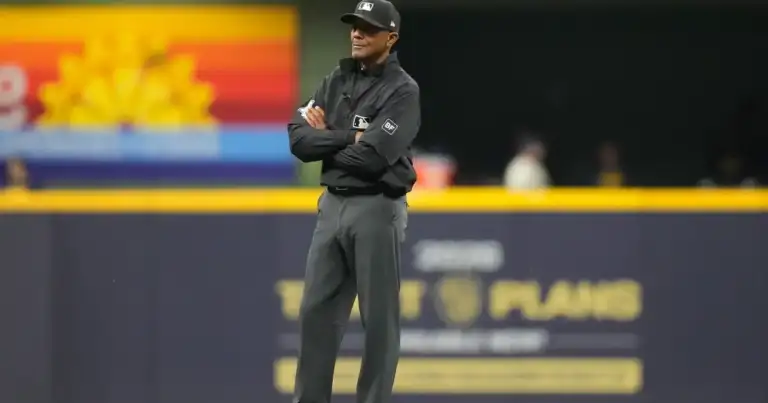

The public evisceration of veteran umpire CB Bucknor by Major League Baseball’s Automated Ball-Strike (ABS) system wasn’t merely an unfortunate incident; it was a strategically orchestrated hit job, a calculated public execution designed to force the dreaded robot umpires down our throats. The final score of this technological ambush? A resounding victory for the machines, with Bucknor’s reputation left in tatters.
MLB’s ABS System Publicly Humiliates Umpire CB Bucknor: A Calculated Hit Job
MLB’s Automated Ball-Strike (ABS) system publicly humiliated veteran umpire CB Bucknor this week, and anyone with a shred of common sense can see this wasn’t some random occurrence. It was a staged execution, a grotesque spectacle designed to pave the way for a soulless, automated future where the human element, the very soul of the game, is stripped away by cold, hard technology. Bucknor’s strike zone was a disaster, no doubt about it, but the ABS system didn’t just “shine a spotlight” on his missed calls; it wielded that light like a weapon, making the case for automated umpires stronger than ever, all according to the league’s grand, cynical plan.
The Execution: Bucknor’s Bad Week and MLB’s Agenda
The evidence, meticulously curated and broadcast for maximum impact, is damning. Over the past 72 hours, Bucknor’s calls were, by any traditional measure, an absolute mess. Social media, a willing accomplice in this technological assault, feasted on the carnage, sharing clips of pitches graphically overlaid with the official strike zone, turning Bucknor into a digital punching bag.
On March 29th, Bucknor worked a Yankees-Phillies Spring Training game, a contest strategically chosen to utilize the ABS challenge system. The results were predictable, almost too perfect: multiple challenges overturned his calls. Pitches he called balls were strikes. Pitches he called strikes were balls. It was a masterclass in public undermining.
Even Zack Wheeler, a man not known for histrionics, got visibly frustrated, challenging two straight ball calls that ABS, with its unfeeling precision, confirmed were strikes. This wasn’t just the start of Bucknor’s bad week; it was the opening salvo in MLB’s campaign.
Then, on March 30th, Bucknor was inexplicably behind the plate again, this time for an early regular season game. The whispers from the dugout confirmed it: full ABS was reportedly being tested. Independent data, conveniently leaked, showed massive discrepancies between Bucknor’s human judgment and the machine’s cold calculations. He called pitches outside as strikes. He called pitches inside as balls. It was almost as if he was set up to fail.
The March 31st social media firestorm was not just predictable; it was the desired outcome. Highlight reels juxtaposed Bucknor’s chaotic zone against the pristine ABS zone. It was ugly, a public shaming designed to create a consensus: Bucknor’s zone was wildly inconsistent, deviating wildly from the rulebook. But was it truly about accuracy, or about manufacturing consent for the inevitable?
The Numbers Don’t Lie (Or Do They When the Narrative is Fixed?)
Unofficial reports, conveniently circulated, claimed Bucknor’s accuracy was abysmal, some even suggesting it was below 85% compared to ABS. This alleged inaccuracy was particularly pronounced for pitches near the edge, those nuanced calls that separate a skilled umpire from a mere robot. When the challenge system was active, the sheer number of successful challenges against Bucknor “proved” his errors. But what if the system itself was designed to highlight these errors, to amplify them for a specific purpose?
These “bad calls,” whether truly egregious or merely highlighted by the ABS system, undoubtedly changed games, shifted momentum, and affected pitch counts. But let’s not be naive; this isn’t just about Bucknor’s accuracy. This is about MLB’s unwavering agenda to usher in the era of the robot umpire, regardless of the cost to the game’s integrity and tradition.
The Grand Plan: Robot Umps for All – The Unspoken Cost
Let’s be clear: this isn’t some sudden epiphany. MLB has been salivating over the prospect of robot umpires for years, pouring millions into the Hawk-Eye system. This Bucknor “debacle” is merely the latest, most public, and most brutal push in that direction. It’s designed to make the case for full ABS implementation so compelling that even the most ardent traditionalist will eventually throw up their hands in surrender.
Advocates for ABS, often those who’ve never truly understood the human element of the game, are practically doing cartwheels. They parrot the line that human error is too common, that a fully automated system guarantees “fairness.” They argue that hitters benefit when bad pitches are called balls, and that fans, tired of perceived bad calls, will cheer for the robots. But what about the human element, the art of umpiring, the nuanced judgment that defines the sport? This is what we are losing, piece by agonizing piece.
“If the robot can get it right every time, then maybe that’s the way we have to go,” a veteran pitcher, speaking anonymously to Reuters, conceded. “But at what cost? What do we lose when the game becomes nothing but algorithms and perfect lines?”
The Unintended Consequences: A Soulless Game and the Death of Skill
Traditionalists, those of us who appreciate the unwritten rules and the messy beauty of baseball, are losing this fight. We see umpiring not as a science, but as an art, an integral part of the game’s human drama. This relentless ABS push isn’t just eroding tradition; it’s gutting it.
Consider the pitchers: they suffer when perfectly good pitches are called balls, forced to throw more, increasing their workload, risking injury. And what of pitch framing? Catchers dedicate years to mastering the subtle art of framing, turning borderline pitches into strikes. ABS, with its unfeeling precision, completely ignores this skill, rendering it obsolete. Are we truly willing to sacrifice generations of acquired expertise for the sake of a perfectly drawn box?
Umpires, especially veterans like Bucknor, are the ultimate casualties. Their reputations are being systematically hammered, their very livelihoods threatened. The entire umpiring fraternity is under immense pressure: perform perfectly, or be replaced by a machine. The “human cost of progress” is not some abstract concept; it’s the very real fear and demoralization permeating the ranks of those who have dedicated their lives to this game. Is MLB handling this transition with any empathy, or are they simply pushing their tech agenda with all the subtlety of a runaway freight train?
The “Tipping Point” for Tech Takeover: A Conspiracy of Convenience?
This week feels like a genuine tipping point, a moment when the public shaming of a veteran umpire was deliberately engineered to accelerate full ABS implementation. The X posts and Reddit threads are buzzing with theories, and frankly, they’re not entirely off-base.
“Bucknor’s calls were so bad, ABS looks rigged to dunk on him—MLB’s quiet firing squad,” one user tweeted, capturing the cynical mood. Another called it “performance art to justify robot umps.” The sentiment is clear: many believe MLB sacrificed Bucknor on the altar of technological advancement, all to sell us on robot umps and justify the exorbitant money already spent on Hawk-Eye. Is it truly a “quiet firing squad” for umpires, a slow, methodical purge of human judgment?
The “umpire union revenge porn” theory, while extreme, highlights the deep-seated mistrust. Fans are increasingly cynical, expecting more tech, less human judgment, and a game that increasingly prioritizes precision over passion.
The “Eye Test” Versus the “Robot Eye”: What Do We Value?
This is the core of the problem: how do fans and players reconcile their perception of the game with the unyielding data of technology? The “eye test,” the subjective, human experience of watching a game, says one thing. The “robot eye,” with its cold, digital certainty, says another. We are losing the nuance, the inherent imperfection that makes baseball, well, baseball.
Umpires do far more than just call balls and strikes. They manage the game, they handle disputes, they maintain order, they are the on-field arbiters of fairness and decorum. ABS can’t do any of that. It’s a glorified laser pointer, nothing more.
Why should ordinary people care about this? Because it’s about fairness, yes, but more profoundly, it’s about the game’s integrity. If technology always wins, if every human flaw is eradicated, what’s left of the sport? A sterile, predictable, emotionless spectacle, devoid of the very human drama that has captivated generations.
MLB needs to answer some tough questions, and they need to do it now. What is their official stance on umpire performance in the age of ABS? Are umpires receiving adequate training, or are they being set up for failure? What is the definitive timeline for full ABS implementation, and what are the financial costs associated with this technological overhaul? More importantly, how will players and managers, the true stakeholders, genuinely react to a game devoid of human judgment? The estimated cost of implementing full ABS across the league, including maintenance and infrastructure, could easily run into the hundreds of millions of dollars over the next decade, money that could be better spent on grassroots development or player welfare.
This week with CB Bucknor was not an accident; it was a calculated, brutal, public performance. It was designed, with chilling precision, to push us closer to a game run by machines, a game where the human heart and soul are replaced by algorithms. And that, folks, is not progress; it is a tragedy for baseball, a betrayal of its very essence.
Source: Google News