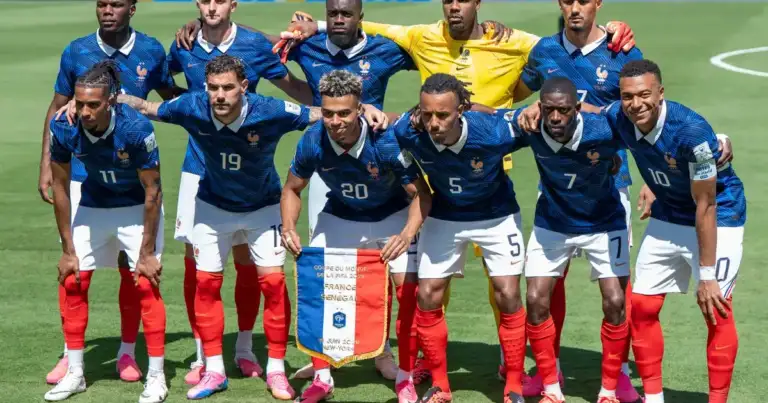

The roar of the crowd, the flash of genius, and the gut-wrenching agony of a decision gone horribly wrong – this is the World Cup, and Ousmane Dembélé just etched his name into its lore, tearing Norway apart with a blistering first-half hat trick in a shocking 4-1 World Cup victory. This wasn’t merely a win for France; it was a masterclass, a statement, and a stark, baffling indictment of Norway’s inexplicable choice to keep their superstar, Erling Haaland, chained to the bench.
Dembélé didn’t just play; he exploded onto the scene like a supernova, a blur of pace and precision. Three times he found the net before the halftime whistle even dared to blow, each goal a dagger to Norwegian hopes.
The French attack, a symphony of movement and ruthless efficiency, carved through the opposition’s defense with an ease that bordered on contempt.
This dominant performance wasn’t just about three points; it was a thunderous declaration, a gauntlet thrown down to every other contender in this tournament. France is here, and they mean business.
Dembélé’s World Cup Statement: A Star Unleashed
This was Dembélé’s moment, a stage perfectly set for a player often lauded for flashes of brilliance but sometimes criticized for inconsistency. Today, he was pure, unadulterated brilliance.
He didn’t just prove he’s a force; he demonstrated he’s a hurricane on the biggest stage, his speed and surgical precision leaving Norway’s defenders grasping at thin air.
Three goals in one half? That’s not just a good day at the office; that’s the stuff of legends, a performance that will be replayed and revered for years to come. It was a defiant roar from a player staking his claim as one of the world’s elite.
But this wasn’t a one-man show. France played with an intoxicating blend of passion and purpose, a collective will that radiated from every blade of grass.
They showcased their terrifying depth and unyielding quality, each player battling for the badge with a ferocity that spoke volumes.
This isn’t just a collection of talented individuals; this is a cohesive unit, a machine finely tuned for victory. Les Bleus look poised, hungry, and utterly ready to embark on a deep, potentially glorious run in this World Cup.
The 4-1 scoreline isn’t just a number; it’s a stark reflection of France’s absolute, undeniable dominance.
From the referee’s first whistle, they seized control of the tempo, dictating play, suffocating Norway’s every attempt to breathe. The Norwegians, frankly, had no answer to the relentless blue tidal wave that crashed over them.
It was a stunning, almost brutal, display of power, skill, and strategic superiority that will send shivers down the spines of future opponents.
Norway’s Haaland Gamble: A Folly of Epic Proportions
But let’s pivot, shall we, and address the colossal, glaring elephant in the room that overshadowed even Dembélé’s heroics: Erling Haaland. The man did NOT play. He was rested.
This was in a World Cup group stage match, against France, one of the tournament favorites. The sheer audacity and bewildering logic of it all is enough to make any football purist tear their hair out.
What in the name of all that is sacred were they thinking? You simply do not rest your most potent weapon, your game-changer, your talisman, in a crucial World Cup fixture.
This isn’t some pre-season friendly or a dead-rubber qualifier; this is the pinnacle of international football, where every single point, every single goal, can mean the difference between glory and ignominy. Fans, pundits, and indeed, every sane person around the globe, are not just scratching their heads; they’re reeling in disbelief.
Haaland isn’t just a goal-scoring machine; he’s a force of nature, a psychological deterrent, a player whose mere presence alters the fabric of a game. His gravitational pull creates space, his relentless running unnerves defenses, and his finishing is often clinical. Leaving him out wasn’t just a mistake; it was a colossal, self-inflicted wound, stripping Norway of their biggest, most terrifying threat and effectively handing France a psychological advantage before a ball was even kicked.
Did Norway genuinely believe they could win without him? Did they criminally underestimate the sheer power of France? Whatever the misguided rationale, it cost them dearly, and it will haunt them.
This decision will undoubtedly be dissected, debated, and ultimately condemned as one of the most egregious tactical blunders in recent World Cup memory.
The Global Fallout: A Seismic Shift
This result isn’t just another scoreline; it sends seismic shockwaves across the entire landscape of international football. France, with this emphatic victory, hasn’t just cemented their status; they’ve roared into contention as serious, undeniable title contenders. They are a team to be feared, respected, and meticulously planned against.
Norway, conversely, now faces an arduous, uphill battle for survival. Their World Cup dream, once vibrant with the promise of Haaland’s goals, has taken a massive, perhaps fatal, hit.
They gambled their tournament on a roll of the dice and lost, spectacularly. As The Guardian rightly pointed out in their post-match analysis, “Norway’s calculated risk against France proved to be an unmitigated disaster.”
Every coach dreams of orchestrating their squad perfectly, of making the clever, unforeseen move. But sometimes, the simplest, most fundamental truth prevails: you play your best hand.
Norway, in a moment of apparent hubris or baffling overthinking, held back their ace. It left them exposed, vulnerable, and ultimately, humiliated.
This isn’t just a loss; it’s a profound statement about priorities, about courage, and about the sheer, unforgiving nature of the World Cup. Was resting Haaland truly worth this ignominious defeat? Was it a calculated risk gone horribly, catastrophically wrong, or merely a monumental misjudgment that will define their tournament?
What Comes Next for Norway? The Road to Redemption (or Ruin)
Now, Norway must confront the brutal reality of their situation. They are fighting for survival, and they need to regroup with an urgency that borders on desperation.
Their
Source: Google News