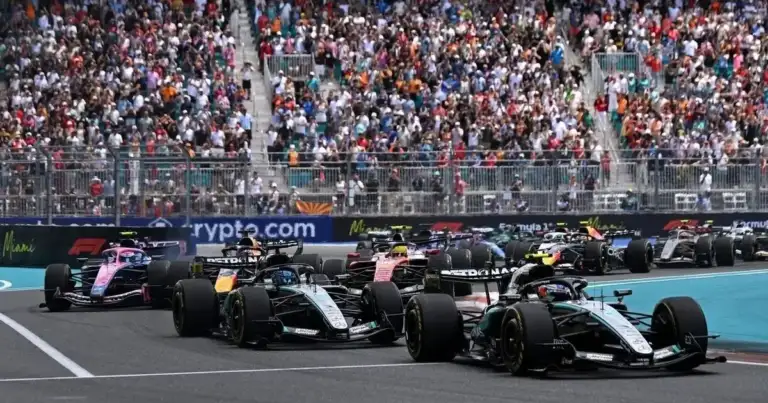

Another Grand Prix, another gut-punch for Mercedes. Team Principal Toto Wolff delivered another public lashing after the Miami Grand Prix.
Lewis Hamilton and George Russell stumbled off the line like novices. Wolff didn’t mince words: these recurring poor starts are “not acceptable” if the Silver Arrows ever hope to sniff a world title again.
He’s dead right, of course. But the real question isn’t whether it’s acceptable; it’s why this chronic failure keeps infecting their Sundays, and what Wolff’s public tantrum really signifies.
Miami wasn’t just another race. It was the latest, most infuriating chapter in a season-long saga of Mercedes shooting themselves in the foot.
Hamilton and Russell, two drivers supposedly among the absolute elite, lost crucial ground before the first corner was even a distant thought. Russell, starting P8, coughed up a position. Hamilton, P6, bled two spots like a rookie on debut.
In a sport where fractions of a second and inches of track position dictate destiny, giving away multiple places on the grid is like starting a heavyweight bout with a clean shot to the jaw. You’re not just on the back foot; you’re flat on your ass, chasing the fight.
Burning through strategy just to recover what was lost for free. What kind of championship contender does that?
The First Corner Fumble: A Championship Killer
Let’s not mince words: a championship isn’t won by a car that can’t get out of its own way for the first two seconds.
The starting grid isn’t just important; it’s the most high-stakes, high-impact moment of any race. It dictates immediate track position, ability to undercut or overcut, and the entire flow of Sunday.
When you consistently bleed positions, you’re not just losing spots. You’re hemorrhaging opportunity, burning precious tire life in traffic, and forcing strategists into damage control.
It’s a self-inflicted wound, race after race.
Mercedes used to be the gold standard for precision and ruthless efficiency. Their starts were legendary, often gaining positions before the first corner, not losing them.
Now? It looks like a damn lottery. Is it a clutch issue? A software glitch? Driver error? Or a toxic cocktail of all three?
Whatever it is, it’s systemic. It’s absolutely crippling their already fragile title ambitions.
You can have all the aero updates and engine power in the world. But if you can’t deploy it cleanly when the lights go out, you’re just polishing a very expensive, very red-faced paperweight.
This isn’t just about a bad day in Miami. It’s a pattern, a gaping wound etched into the very DNA of their current race package. And it stinks.
Wolff’s Public Whipping: Management or Manipulation?
Wolff’s declaration that these starts are “not acceptable” rings with the primal frustration of a man watching his empire crumble.
But let’s peel back the layers here. Is this a genuine admission of leadership failure, a moment of raw vulnerability from the Silver Arrows’ boss?
Or is it a calculated, ice-cold move to publicly light a fire under his engineering teams? He could be simultaneously managing expectations and deflecting a mountain of pressure from himself.
My money isn’t just on the latter; it’s a certainty. Albeit with a healthy dose of genuine, gut-wrenching exasperation mixed in. This isn’t just frustration; it’s a tactical strike.
When a team principal of Wolff’s stature goes public with such a blunt, brutal assessment, it’s never just for the media.
It’s a message, loud and clear, echoing like a thunderclap through the factory halls in Brackley and Brixworth. It puts the onus squarely on the technical departments responsible for the car’s launch performance.
He’s drawing a line in the sand, not just for the engineers, but for everyone. It’s a stark signal to the board, sponsors, and the wider F1 world that he’s still in control.
He is still demanding excellence, even as his once-invincible team struggles in a post-dominance era. This isn’t just management; it’s a ruthless power play, designed to shake the foundations.
“These starts are killing us. They are not acceptable if we want to compete for world titles.” – Toto Wolff
The Mercedes machine, once an unstoppable, precision-engineered force, now shows gaping cracks in its fundamental operations.
This isn’t a minor setup tweak or a bad pit stop; it’s a foundational issue. A rot from within is costing them dearly.
In a sport where financial investment is astronomical and brand prestige is everything, repeated failures have tangible consequences. These go far beyond just race results.
Sponsors aren’t paying for podiums; they’re paying for wins. Boardrooms demand returns, not public declarations of “unacceptable” performance.
The pressure cooker is boiling, and someone’s going to get scalded.
Let’s be brutally, uncomfortably honest. Toto Wolff’s “not acceptable” isn’t some sudden epiphany or profound self-realization.
It’s a calculated, cold-blooded strategic maneuver. It’s the sound of a man desperately trying to regain control of a narrative and kickstart a stagnant engineering department.
He is frantically protecting his own formidable reputation and the immense financial interests tied to the Mercedes-AMG Petronas brand. The sheer, unadulterated hypocrisy isn’t lost on anyone.
Mercedes once relentlessly exploited every millimeter and millisecond, leaving rivals gasping for air from the moment the lights went out. Now, they’re on the receiving end of that same ruthless efficiency, or lack thereof.
The sting isn’t just palpable; it’s a festering wound.
This isn’t just about winning races; it’s about the bottom line, the cold, hard cash.
It’s about maintaining the illusion of a championship contender, even when fundamental performance metrics are failing spectacularly. Wolff isn’t just frustrated; he’s a CEO managing a multi-billion-dollar enterprise.
This enterprise isn’t delivering its core promise. His public statements are less about team morale and more about putting the fear of God into those responsible for the car’s most basic, crucial function: getting off the line cleanly.
This isn’t a plea for understanding; it’s a demand for results, delivered with the subtlety of a sledgehammer. The “unacceptable” isn’t for the fans; it’s for the engineers, the investors, and anyone who thinks Mercedes can afford to be anything less than perfect.
He’s drawn a line in blood. The implication is clear: fix it, or start updating your CVs. The clock is ticking, and Toto Wolff isn’t known for his patience.
Source: Google News