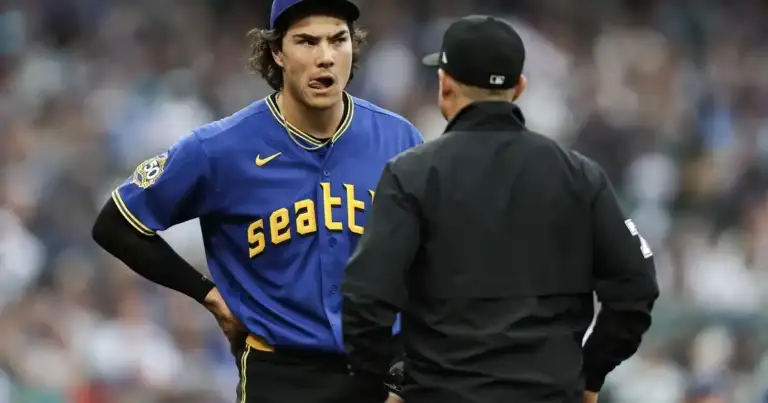

Another starter shelled, another game squandered, and the Seattle Mariners are once again staring down the barrel of their own strategic missteps. Bryan Woo, the supposed future, got absolutely roughed up by the Kansas City Royals in a dismal 7-6 defeat on April 30, 2026. This wasn’t just a bad outing; it was a glaring red flag for a franchise already teetering on the brink of financial and competitive mediocrity.
Woo lasted a paltry 4.1 innings, surrendering 6 earned runs on 8 hits, including two absolute moonshots. He walked two batters and struck out a measly three, throwing 88 pitches that looked less like big-league stuff and more like batting practice. The Royals wasted no time, with Salvador Perez launching a 3-run bomb in the first inning and Bobby Witt Jr. added a solo shot in the third, effectively burying the Mariners before the crowd had settled.
The Steep Price of Inconsistency
The Mariners’ record now sits at a wholly unremarkable 16-17, while the Royals, no world-beaters themselves, improved to 13-19. You simply cannot contend in the AL West, or anywhere else for that matter, when you’re spotting opponents early leads with such alarming regularity. Woo’s struggles are no longer a blip; they are a disturbing pattern, an anomaly that has become the norm.
He’s coughed up 5 home runs in his last three starts alone. This isn’t just a serious problem; it’s a foundational crack in the team’s entire pitching-first philosophy, one that threatens to undermine their season and their future cap flexibility.
His fastball command was non-existent. You can’t leave pitches up in the zone against professional hitters and expect to get away with it. This isn’t some new-fangled analytics problem; it’s basic pitching mechanics. You hit your spots, or you get hammered. Simple as that.
“Bryan just didn’t have his best stuff tonight. He left some pitches up, and a good hitting team like the Royals will make you pay. I was proud of how the guys fought back, but you can’t spot a team that many runs and expect to win consistently.”
— Scott Servais, Mariners Manager
Manager Scott Servais might talk about ‘heart,’ but frankly, heart doesn’t win you games when your starter is serving up meatballs. Yes, Julio Rodriguez delivered a critical RBI double in the eighth, sparking a late three-run rally. But relying on heroic comebacks is a fool’s errand, not a sustainable strategy.
The bullpen, to their credit, performed admirably after Woo’s early exit, allowing only one run over 4.2 innings. But how many times can you ask your relievers to bail out a starter who can’t get out of his own way? This isn’t just about fatigue; it’s about the entire pitching staff’s mental and physical load, and it’s a recipe for disaster down the line.
Woo’s Future and the Front Office’s Blunder
This isn’t merely about one rotten start; it’s about the entirety of Bryan Woo’s long-term viability. Is he truly a consistent big-league starter, capable of anchoring a rotation for years to come? Or is he, as many traditional scouts might have always suspected, destined for a less impactful role, perhaps a middle-relief arm at best?
The Mariners, and more specifically, Jerry Dipoto‘s front office, need answers yesterday. They’ve sunk significant development resources into him, not to mention a valuable roster spot. His current performance obliterates his trade value and casts a dark shadow over his projected role in any future playoff push.
This isn’t just about a player; it’s about an asset depreciating rapidly.
The murmurs among the fanbase are no longer murmurs; they’re a roaring chorus of discontent. Fans on social media are already, and perhaps rightly, calling him “cooked” and a “prospect darling turned pumpkin.” This isn’t just regression; it’s a full-blown collapse of expectation.
It hits the front office where it hurts most: their carefully constructed, analytics-driven strategy of developing cheap, young arms. If Woo can’t hold down a rotation spot, it doesn’t just impact pitching depth; it blows a hole in their entire financial planning, forcing them to look at options they desperately wanted to avoid.
Every inconsistent start from a young player like Woo isn’t just a loss in the standings; it’s a drain on the franchise’s resources, both human and financial. It means more stress on an already overworked bullpen, shortening careers and increasing injury risk. It means the offense has to be superhuman every night, which is an unsustainable ask.
Most importantly, it directly impacts the team’s ability to compete within their self-imposed budget. This forces them to consider dipping into the treacherous free-agent market for expensive, stop-gap solutions that rarely pan out. The old adage remains true: you develop your own, or you pay a premium – and often, you pay for someone else’s problems.
Let’s be clear: this isn’t about some fancy new metric or a ‘spin rate’ anomaly. This is about a pitcher’s fundamental ability to get outs, to command the zone, and to execute. When the Mariners’ entire competitive strategy hinges precariously on the strength of their rotation, a struggling arm like Woo isn’t just a minor setback; he becomes a massive, unignorable liability.
The front office, specifically Jerry Dipoto, needs to make a stark decision. Is this a temporary slump that can be ‘coached up,’ or do they need to drastically adjust their expectations – and more importantly, their budget – for what Bryan Woo can truly deliver to this franchise? The longer they wait, the more expensive the answer becomes.
The cold, hard truth is that the Mariners’ playoff hopes, and indeed their entire financial solvency, are inextricably linked to consistent starting pitching. If Woo cannot deliver, Jerry Dipoto and his analytics-driven front office aren’t just facing a ‘major problem’; they’re staring into a gaping financial abyss. They’ll be forced to either burn out the bullpen, concede games they should win, or, worst of all, wade into the free-agent shark tank for a costly, desperate fix.
None of these options come cheap, and all of them spell disaster for a franchise that seems determined to learn the same expensive lessons over and over again. The unwritten rule of baseball, after all, is that you pay for your mistakes, and the Mariners are racking up a hefty bill.
Source: Google News