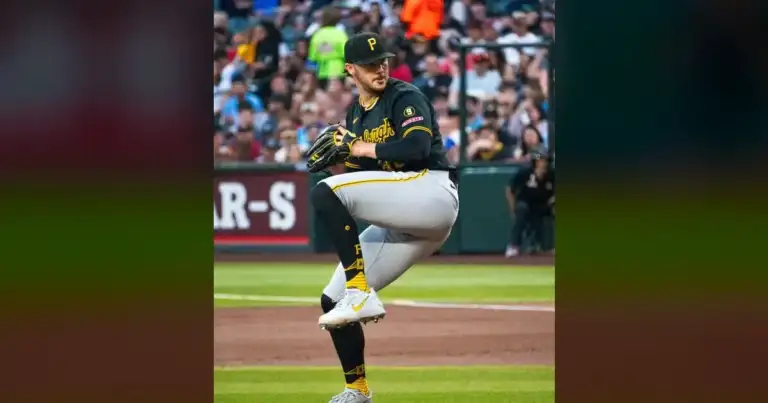

Forget your fancy algorithms and “player development models.” Justin Wrobleski’s journey to the 2026 National League All-Star team is a cold, hard lesson in old-school grit, not sabermetrics. It’s a financial boon for the Los Angeles Dodgers and a slap in the face to anyone who thinks a demotion is a career death sentence.
This isn’t some analytics-driven fluke, cooked up in a spreadsheet by some kid who’s never thrown a pitch in anger. This is old-school grit, pure and simple, paying dividends not just on the field but directly into the Dodgers’ coffers. His stunning turnaround truly began with a brutal, yet necessary, dose of reality in late 2024.
Back then, Wrobleski, toiling for the Double-A Tulsa Drillers, wasn’t just hitting a wall; he was running headfirst into it. His ERA ballooned north of 7.00 across four disastrous starts. His command evaporated, his breaking pitches hung like laundry on a still day.
The Dodgers, ever so delicately, called it a “reset” – a corporate euphemism for “you’re terrible, go figure it out elsewhere.” They shipped him down to High-A Great Lakes. A demotion, plain and simple, no matter how many focus groups you run.
The Demotion: A Necessary Evil
Let’s cut through the corporate jargon. A “reset” to High-A is a demotion, a public humiliation for any aspiring big leaguer. It’s a gut-punch that sends lesser prospects packing. But for Wrobleski, it was the exact bitter medicine he needed.
He wasn’t sulking; he spent three intense weeks in the minor league wilderness, not chasing some nebulous “spin rate” but grinding on the fundamentals.
He wasn’t tweaking some obscure launch angle based on predictive models that couldn’t predict rain. He was rebuilding his delivery from the ground up, rediscovering his pitch efficiency, and finding the rhythm that the game’s best pitchers have always possessed.
This isn’t about fancy algorithms or data-driven “optimizations.” This is about sweat, repetition, and the kind of dedicated craftsmanship that seems to be a lost art in today’s game.
“It was a necessary wake-up call,” Wrobleski said in recent interviews. “It made me get back to basics.”
When he resurfaced in Tulsa in September 2024, the transformation was palpable. He didn’t just finish that season strong; he pitched with a renewed purpose, a chip on his shoulder.
That momentum wasn’t some statistical anomaly; it was earned, carrying him through a dominant 2025 campaign in Double-A, where he made opposing hitters look foolish.
His undeniable performance forced the organization’s hand, earning him a mid-season promotion to Triple-A Oklahoma City. There, he didn’t just tread water; he continued to carve up lineups, proving decisively that he wasn’t just talented, but possessed the mental fortitude to overcome adversity – a trait far more valuable than any prospect ranking.
Dodgers’ Smart Money Play
By Spring Training 2026, Wrobleski wasn’t just turning heads; he was kicking down the door. While he began the season in Triple-A, the inevitable happened.
A rash of injuries to established, high-salary starters – the kind of cap headaches every GM dreads – left the Dodgers with no choice but to call up the kid. It was less a strategic move and more a desperate necessity, but it paid off handsomely.
Called up in late April, Wrobleski has been nothing short of a revelation, a lifeline for a pitching staff that was bleeding cash and innings. This isn’t just some heartwarming, feel-good story for the local papers; this is a financial masterstroke, a textbook example of how a savvy front office leverages its farm system to maintain contention without breaking the bank.
Consider this: as a pre-arbitration player, Wrobleski is currently pulling down a salary barely north of the league minimum – let’s ballpark it around $750,000 for the 2026 season. He’s an All-Star caliber arm, delivering front-line production at a bargain basement price. That kind of value, folks, is the bedrock upon which genuine championship teams are built, freeing up precious cap space for other big-ticket acquisitions.
His immense value to the team’s salary cap cannot be overstated. It’s not just about his current low salary; it’s the flexibility it provides. This allows the Dodgers to absorb other massive contracts, to pursue high-priced free agents, or to extend their existing superstars without triggering luxury tax penalties.
Yes, his future arbitration earnings will skyrocket, and his eventual free agency will command a king’s ransom. But for the next few seasons, he’s arguably the biggest steal in baseball, a diamond found in the rough that will pay dividends for years.
The Irrefutable Ledger: Numbers Even I Can’t Argue With
Now, I’m on record: I detest what the analytics crowd has done to the soul of this game, turning players into data points and instinct into algorithms. But even I, a staunch traditionalist, must concede that numbers, when presented plainly and without a ‘WAR’ attached, still tell an irrefutable story. And Wrobleski’s ledger, as of July 13, 2026, is undeniable: an 8-3 record that speaks volumes.
His ERA sits at a stellar 2.65 across 15 starts, totaling 95.0 innings pitched of genuine quality. He hasn’t just been good; he’s been dominant, piling up 118 strikeouts against a paltry 28 walks. That, my friends, is the definition of control and power, a rare combination that separates the pretenders from the true aces.
His 1.05 WHIP is elite, proof of his ability to keep baserunners off. The 11.17 K/9 rate isn’t just ‘missing bats’; it’s making hitters look foolish, swinging through air. His slider snaps, his changeup disappears, and he’s carved up right-handed hitters with the kind of precision that makes you wonder why he ever struggled.
This didn’t come from a computer program spitting out optimal pitch sequences or a biomechanics lab analyzing every twitch. It came from the oldest playbook in baseball: hard work, stubborn resolve, and a kid taking a humbling demotion to heart, using it as fuel instead of an excuse.
“He showed uncommon mental toughness,” said Dodgers Manager Dave Roberts. “He made the adjustments.”
This isn’t just a feel-good story; it’s a stark reminder to every front office obsessed with their digital dashboards and predictive models. Sometimes, the best ‘analytics’ is simply a manager looking a player in the eye and telling him, “You’re better than this.”
It’s a validation of old-school player development, demonstrating perseverance, and a cold splash of reality for the modern game. So, the next time some wunderkind with a laptop tries to tell you how to fix a struggling pitcher, just remember Justin Wrobleski.
Sometimes, you don’t need a fancy algorithm; you just need to send a guy down to figure things out. The Dodgers are now reaping millions from that simple, painful truth. What’s more traditional than that?
Source: Google News