
Arsenal’s Premier League title dreams are being actively strangled by a ghost from two seasons past. A spectral hand reaches from a moment of controversy to choke their present ambitions. Forget the recent 1-1 draw; the true turning point wasn’t a missed penalty or a VAR decision.
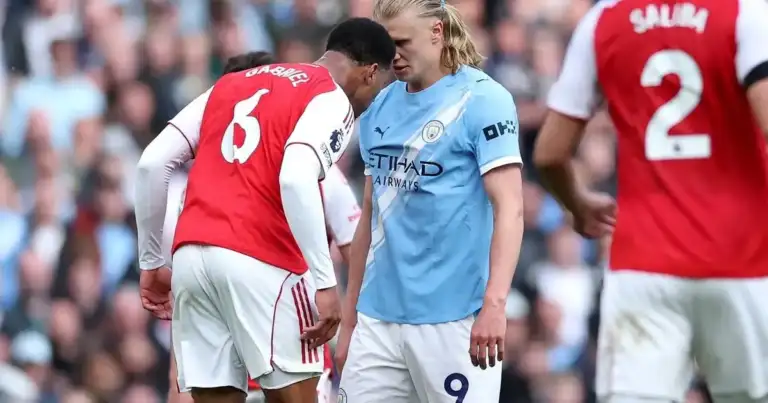
It was back in September 2024, in a gritty 2-2 Etihad thriller. Erling Haaland, that golden-haired Viking, chucked the ball at Gabriel’s head after a shove. That wasn’t just a cheap shot; it was a psychological warfare tactic that, in hindsight, might have already sealed Arsenal’s fate.
The September Shove: A Poisoned Seed Planted
Arsenal diehards across every digital forum, from Reddit to X, didn’t just call it a cowardly act. They saw it as a brazen assault on the very spirit of the game. They screamed for a red card for Haaland, a righteous expulsion for pure petulance.
Instead, the incident became a festering wound, a symbol of perceived injustice that has never truly healed. Fans branded Haaland a “diving robot,” seeing him as a favored son of the footballing gods. This fueled a deep-seated conspiracy fever among the Gunners faithful, a belief that the deck was stacked against them.
Gabriel’s post-match “It’s a war” declaration wasn’t just a quote; it was a battle cry. It intensified the narrative of a warrior saint denied justice by a complicit officialdom. Meanwhile, the Cityzens, smug in their perceived dominance, gloated.
They branded Gabriel the “red-card merchant,” dismissing Arsenal’s outrage as bitter wails of perennial bridesmaids. This single, contentious moment—whether a save, cheap shot, or tactical genius—didn’t just plant doubt. It injected a potent poison into the Arsenal psyche, setting a psychological precedent.
This precedent has manifested in crucial, title-defining moments ever since. It wasn’t just a game; it was a declaration of war. Arsenal, it seems, has been fighting it on the referee’s terms ever since.
April’s Stalemate: The Bill Comes Due
Now, fast forward to April 6, 2026. Arsenal hosted Manchester City at the Emirates, a coliseum where stakes were existential. This was their chance to seize destiny, to bury rivals, to heal psychological scars.
The match ended in a soul-crushing 1-1 draw. Erling Haaland, the same man who sparked the initial fury, opened the scoring in the 34th minute, twisting the knife with cruel irony. Bukayo Saka, Arsenal’s beacon of hope, equalized in the 67th minute, but it was too little, too late.
This result leaves Manchester City with a slender, yet psychologically crushing, two-point lead over Arsenal. With just four matches remaining for both teams, the margins are razor-thin, the pressure unbearable.
And let’s not forget Liverpool, a lurking, predatory threat, three points behind Arsenal. They are ready to pounce on any further misstep. This isn’t just a three-horse race; it’s a gladiatorial contest where every stride carries the weight of millions.
The Crushing Weight of the Table and the Bank
The draw wasn’t merely two dropped points; it was a seismic psychological blow. It was a self-inflicted wound that could prove fatal. Arsenal had the golden opportunity to seize control of their own fate, to dictate the terms of the title race on their home turf.
Instead, they faltered, hesitated, and choked. This isn’t just a narrative; it’s a damning indictment. Arsenal, despite all their progress, still lacks that cold, ruthless killer instinct required to close out vital games when the spotlight burns brightest.
“They are an incredibly strong team now. To come here and get a point, especially after leading, shows our character, but we know the job is not finished. Every game now is a final.”
— Pep Guardiola, Manchester City Manager, as reported by Reuters
Guardiola’s words, delivered with casual confidence, are a masterclass in psychological warfare. He knows his team possesses an unshakeable mental fortitude. Arsenal, for all their “incredible spirit,” still desperately craves this.
Character, admirable as it may be, does not win titles. Money, however, talks in this league with a thunderous roar. A title loss isn’t just about bragging rights; it means tens of millions in lost revenue.
This is a direct hit to the club’s bottom line. It impacts future sponsorship deals, diminishes player valuations, and restricts the transfer budget. The difference between champions and runners-up isn’t just prestige; it’s a gaping chasm in financial power and market appeal.
For Arsenal, another near-miss isn’t just an emotional disaster; it’s a financial catastrophe. It jeopardizes their long-term project and blows to club prestige will ripple through fan morale for years.
And what of Mikel Arteta? His job security, despite building a resilient squad, now hangs by a thread. Resilience without silverware is a dangerous, unsustainable game in the cutthroat Premier League.
How many more seasons can the board tolerate “progress” without tangible triumph?
“We showed incredible spirit to come back. This team doesn’t give up. We are still in this title race, and we will fight until the very last second.”
— Mikel Arteta, Arsenal Manager, in a post-match conference
Arteta’s words ring hollow. They sound good, they project defiance, but the cold, hard reality is stark: they needed three points against City. They got one. In the brutal arithmetic of a title race, one point, or the lack thereof, can mean the difference between glory and another season of agonizing regret.
The Crushing Reality of a Self-Inflicted Wound
So, was Haaland’s ‘save’ of Gabriel from a red card the moment Arsenal lost the title? Absolutely not. That was merely a moment of controversy, a spark for fan fury that ignited a long-burning resentment.
Title races are not lost on single, isolated incidents
Source: Google News