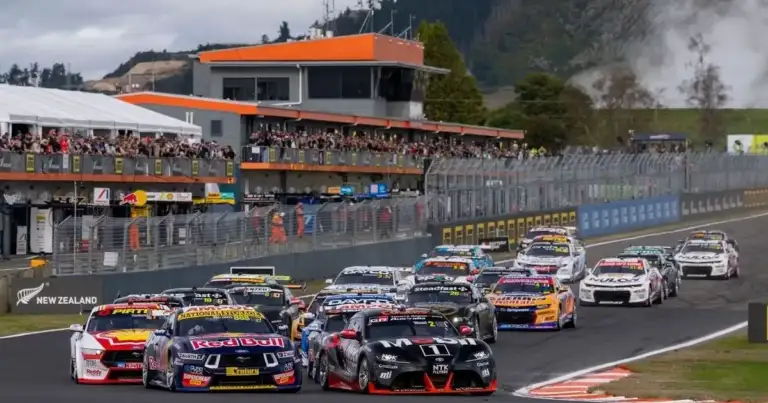

Forget fair racing; this is a full-blown witch hunt! Just when we thought Supercars might actually get exciting, the suits pull their favorite trick: a parity investigation triggered after Toyota’s Taupo win. Give me a break! This isn’t about leveling the playing field; it’s a gutless, knee-jerk reaction to a team daring to actually win.
Ryan Wood, driving a Toyota, didn’t just win at Taupo; he dominated. He secured the Jason Richards Trophy in an emotional home victory. This wasn’t a fluke; it was a legitimate, hard-fought triumph.
Toyota Gazoo Racing clinched this win in just nine races, the fastest a new entrant has ever achieved victory. This success should be celebrated, a clear demonstration of grit and engineering. Instead, regulators are scrambling, desperate to punish success.
Chevrolet’s Collapse: The Real Scandal
This whole parity investigation isn’t just premature; it’s an insult to anyone who understands racing. Toyota earned that win, plain and simple. They came, they saw, they conquered, and they did it faster than anyone before them.
The real story here, the one the suits are trying to bury, is the absolute implosion of Chevrolet. These guys used to be the untouchable titans of the track. Now they can’t buy a win.
Taupo didn’t just expose their dramatic collapse; it laid it bare for the world to see. Chevrolet was locked out of the top ten in qualifying. That hasn’t happened since 1990!
This is a historic, catastrophic failure, not a minor hiccup. Why aren’t we investigating *that*? Why isn’t the focus on why the supposed kings of the hill suddenly look like amateurs?
Nobody with a brain is outraged by Toyota’s legitimate performance. We’re disgusted by this entire process. Toyota’s win proves the system *can* work; new blood *can* rise to the top.
It’s not evidence the system is broken. It’s evidence the old guard can’t handle competition. The real controversy, deserving every headline, is Chevrolet’s sudden, spectacular drop. Anything else is a distraction, a smokescreen to hide the inconvenient truth.
BoP: Balance of Performance or Political Bullshit?
Ah, the infamous Balance of Performance, or BoP. The high-and-mighty FIA and ACO parade it around like a scientific marvel. They claim it’s a sacred algorithm designed for perfect parity.
They collect mountains of data: lap times, sector times, top speeds, even fuel consumption. Then, with a flick of a wrist, they “adjust” things. Minimum weight, engine power, energy per stint, aerodynamics – it all sounds clinical and fair on paper.
But let’s be real. In practice, BoP is less about scientific precision and more about political maneuvering. It’s a constant struggle to keep things “even,” especially when a new manufacturer shakes up the established order.
Toyota Gazoo Racing has dominated WEC with their monstrous GR010 Hybrid. Their success naturally draws scrutiny. But there’s a Grand Canyon-sized difference between scrutinizing success and actively punishing it. This isn’t about uncovering an unfair advantage; it’s about stifling a new winner, plain and simple.
Chatter around BoP adjustments always reaches a fever pitch before any major race. They’ll tell you it’s to “tighten the field,” to make for more exciting racing. What it often does is shift the problem, creating new, artificial challenges.
They move the damn goalposts! One minute, a team is compliant; the next, they’re too fast. They can change parameters specifically for Toyota, or tweak them for everyone else. This ensures no one gets too comfortable, too dominant. It’s a game of smoke and mirrors, designed to keep everyone in check, not to reward true excellence.
Overreaction or Just Pathetic Management?
This entire parity investigation triggered after Toyota’s Supercars Taupo win doesn’t just smell fishy; it stinks to high heaven. Why punish a team that finally broke through the old guard? Ryan Wood’s emotional home win was a genuine achievement.
It was a shot in the arm for the entire sport. It was pure, unadulterated racing brilliance. And what do the regulators do? They launch an “investigation.”
Forget what “commentators are asking.” I’m asking: Was this investigation triggered by an actual imbalance, or by the sheer audacity of an unexpected winner? It reeks of oversensitivity.
Regulators are constantly overcorrecting, chasing their own tails to control every variable. They’re so busy fiddling with numbers, so obsessed with engineering close finishes, they miss the point of racing. They miss the raw talent, the hard work, the sheer will to win that defines a champion. They miss the real battles that captivate fans and make legends.
This isn’t an isolated incident, either. We see this bureaucratic meddling everywhere. Look at NASCAR, where their rules packages change more often than my underwear. It’s all “supposed” to create parity. What it actually creates is frustration for teams, who can’t build any consistency, and boredom for fans, who just want to see pure racing, not a rigged spectacle.
The Ever-Shifting Goalposts of Control
The FIA is no stranger to this kind of nonsense. They constantly adjust things in Formula 1. Cost cap cheating is a regular complaint, team orders still exist under thinly veiled excuses, and the whole damn system often feels rigged – either for certain players or blatantly against them. It’s a circus of bureaucracy, not a pure competition.
The Toyota Supercars Taupo win was a breath of fresh air. A new team, a new winner, a genuine underdog story. It screamed that hard work still pays off, that fresh blood can succeed, and that the spirit of competition isn’t dead yet.
But the regulators? They can’t stand it. They hate anything that disrupts their carefully constructed narrative.
They crave uniformity. They want everyone to be exactly the same, running identical lap times, leading to predictable, manufactured outcomes. But racing isn’t about that!
It’s about pushing limits, finding that razor-thin edge. It’s about winning when no one, especially the establishment, expects it. It’s about the unexpected, the impossible made real.
This investigation doesn’t just undermine the sport; it questions legitimate success. It sends a chilling message to every team: don’t try too hard, don’t win too much, because if you do, they’ll just change the rules on you. It’s a pathetic, sorry state of affairs for a sport that claims to celebrate competition.
The regulators need to get out of the way. Let the teams race. Let the drivers drive. Stop messing with the BoP every five minutes. Stop launching investigations for every unexpected win.
Let the best team win, let them earn it. Let them bask in their glory, not face an inquisition. This constant meddling suffocates true competition and makes a mockery of fair play.
The real problem isn’t Toyota’s win. It’s the constant, crippling fear of genuine dominance among the rulemakers. They’re so terrified of someone being truly exceptional, they’re willing to flatten the entire field into bland mediocrity.
What a joke. They should be celebrating Toyota’s breakthrough, hailing it as a triumph for the sport. Instead, they’re digging through data, looking for an excuse. They’re trying to level the field so much they’ll just flatten it completely.
It’s time for these bodies to back off. Let the teams compete. Stop with the endless adjustments. Stop with the pointless investigations. Let racing be racing.
This whole mess just proves one thing: the suits are more interested in control than competition. They’re terrified of genuine excellence, and they’re killing the sport one “parity investigation” at a time. It’s a disgrace.
Source: Google News