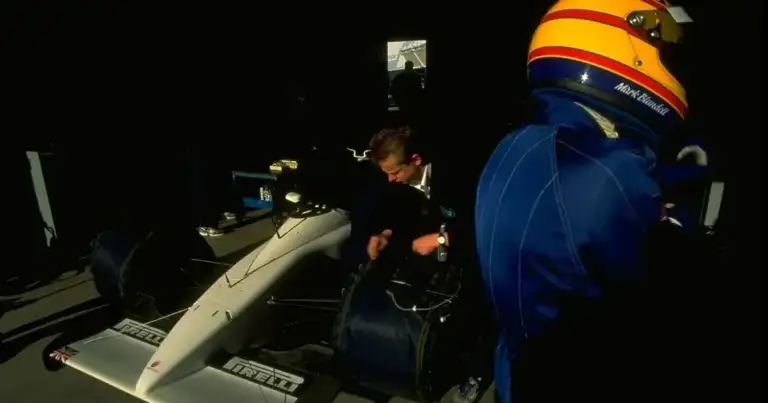

When Mark Blundell Threw Away a Career-Defining Williams F1 Role
Mark Blundell blew his chance at F1 greatness by ditching a Williams test driver role in 1991 for a race seat at Brabham—a team already sinking fast. Instead of waiting his turn with a dominant squad, he jumped into a losing fight and never recovered.
Williams was the team to beat in the early ’90s, with Mansell, Prost, and Hill winning championships. Blundell’s choice was like trading a first-class ticket on Concorde for an economy seat on a busted plane. The fallout? A career that peaked far below its potential.
The Cold, Hard Facts
- 1991: Blundell turns down the prestigious Williams test role.
- 1991 Season: He races for Brabham, a team spiraling toward obscurity.
- Williams Dominance: Multiple Constructors’ and Drivers’ Championships in the early ’90s.
- Williams Drivers: Mansell, Prost, Hill – elite talents locked in championship battles.
- Blundell’s Career Trajectory: Never lands a full-time Williams seat; pivots to IndyCar with moderate success.
Blundell’s ego and impatience cost him dearly. He wanted to race immediately rather than develop quietly with Williams. But patience was the key to F1 success. Instead, he joined a fading team and watched his momentum vanish.
Why This Story Still Matters
F1 is a ruthless game where timing and politics often trump talent. Blundell’s story exposes the myth that raw speed alone guarantees success. Williams had the winning package, but Blundell’s impatience shut the door on a real shot at glory.
His later IndyCar success shows he had skill, but the F1 window slammed shut. Now a motorsport commentator, Blundell’s legacy is that of a reliable backup, never the star. The harsh truth: F1 glory demands ruthless patience and smart career moves. Blundell’s gamble cost him a chance to battle Damon Hill for the title.
Public Backlash and the Brutal Reality
When Blundell aired his regrets, fans were merciless. Social media mocked his “what if” fantasies as mid-tier whining. One viral tweet nailed it:
“Williams test driver in ’91 was basically Prost’s shadow; you’d have been Hill’s spare tire, not champion.”
The public sees Blundell’s move not as brave but naïve. He gave up a prestigious role that could have fast-tracked him at the best team to chase immediate glory with a doomed outfit. The truth? He was never destined to be a Williams star—just a backup plan inflated by ego.
The What-Ifs Are Poison
Could Blundell have been a champion at Williams? No chance. Those seats were locked tight. Would modern driver management have saved him? Maybe. But F1’s core remains the same: timing, money, and connections rule.
Blundell’s “career-defining” moment was a mirage. He wasn’t the next champ, just a talented racer who bet wrong. His IndyCar wins prove he’s no joke, but his F1 legacy is defined by a missed shot at greatness.
The Final Lap: A Lesson for All
Blundell’s story is a brutal lesson for every young driver dreaming of F1 glory. This sport isn’t about speed alone—it demands ruthless career moves, patience, and knowing when to hold your ground. His choice to walk away from Williams blew up spectacularly.
Next time a driver whines about missed chances, remember Blundell: a solid racer, a hustler, but never a champion. In Formula 1, being fastest isn’t enough—you have to be smartest.
“Sometimes it’s not just about being fast; it’s about being in the right place at the right time.” – Mark Blundell
He had the speed, but missed the timing. That’s why Williams passed on him, and his career detoured into IndyCar instead of F1 glory.
focus_keyword: career-defining Williams
meta_description: Mark Blundell gave up a career-defining Williams F1 role in 1991, choosing a Brabham race seat instead and missing his shot at F1 greatness.
network_promo: Craving deeper motorsport drama? Check out DailySportsEdit for explosive takes on the hottest racing rivalries and driver feuds shaking up the tracks worldwide.
Source: Google News