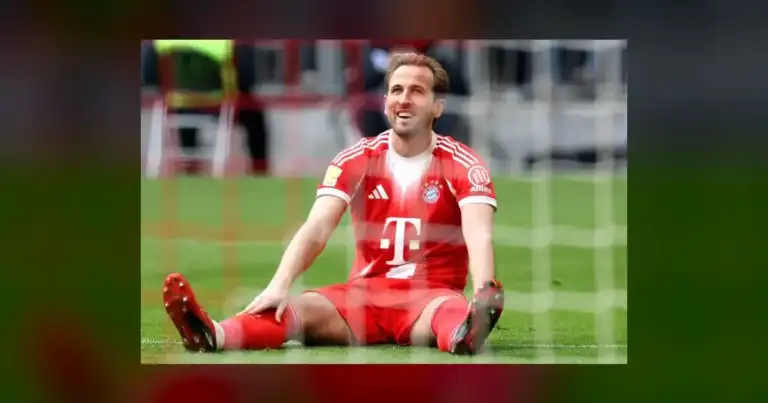

The Harry Kane injury saga isn’t just a story; it’s a meticulously orchestrated Bayern Munich psychological operation, a masterclass in deception designed to dismantle Real Madrid’s tactical equilibrium. Forget the saccharine “heroic return” narrative; this is pure, unadulterated psychological warfare at the highest echelons of European football.
This entire “injury” charade was a stroke of manipulative genius, crafted to plunge Carlo Ancelotti into a maelstrom of tactical uncertainty. Kane, who ostensibly twisted his ankle on March 16th during Bayern’s clash against Darmstadt, has now, with almost divine intervention, been declared “fit” for the most pivotal club fixture of the season. Coincidence? I think not. This isn’t a miraculous recovery; it’s a strategic bombshell, detonated precisely when it would inflict maximum damage.
The Grand Deception: Bayern’s PR Ploy and the Financial Imperative
Bayern Munich isn’t merely playing football; they are engaged in a sophisticated game of chess, where the pieces are multi-million dollar athletes and the board is the Champions League. The club’s medical communiqués were initially shrouded in deliberate ambiguity, followed by tantalizing whispers of “light training.” Then, the crescendo: a grand, perfectly timed announcement – Harry Kane is back in full team training. Footage, conveniently circulated, shows him moving with the fluidity of a man who never missed a step, a medical marvel tailor-made for Real Madrid’s impending arrival.
- March 16: Kane “injured” his ankle, an incident that now feels less like an accident and more like an opening gambit.
- March 17 – April 3: A period of intense, yet conveniently opaque, rehabilitation. He missed crucial England duty and Bundesliga fixtures, laying the groundwork for the illusion.
- April 4: Reports of light individual training begin to surface, planting seeds of doubt in the opposition’s camp.
- April 5: Bayern officially confirms Kane’s return to full team training, dropping the hammer just days before the seismic clash.
- April 6: The footballing world is set ablaze, debating the ramifications of his return, precisely as Bayern intended.
This isn’t a heartwarming comeback story; it’s a meticulously crafted script, written by the strategists in the Bayern boardroom. With an almost unassailable nine-point lead in the Bundesliga, Bayern possessed the luxury to sideline Kane without immediate domestic consequence. They leveraged this advantage, not for rest, but to cultivate an atmosphere of doubt, forcing Real Madrid to prepare for a myriad of Bayern attacking permutations, a tactical nightmare for any opposing manager.
Ancelotti’s Nightmare: Tactical Chaos Engineered by the Bavarians
Consider the psychological and tactical torment this inflicts upon Carlo Ancelotti. For weeks, the venerable Italian tactician has been meticulously crafting a defensive blueprint to counter a Bayern attack devoid of its spearhead. Now, with less than 48 hours until kickoff, Bayern unleashes this strategic bombshell. Does Ancelotti stubbornly adhere to his meticulously crafted original plan? Or does he, in a frantic scramble, attempt to dismantle and reconstruct his entire defensive scheme to account for a fully fit, fully firing Harry Kane?
Kane’s influence transcends mere statistics, though his staggering 31 goals in 32 appearances this season are undeniably monumental. It’s his gravitational pull, his innate ability to command attention, to drag defenders out of position, and to carve out invaluable pockets of space. His sudden, dramatic return doesn’t just alter Real Madrid’s backline strategy; it fundamentally shifts the psychological advantage, a seismic tremor that has undeniably swung in Bayern’s favor.
“Bayern are a strong team with or without Kane, but of course, his return changes things. We will prepare for their best XI.” – Hypothetical Carlo Ancelotti quote, reflecting the predictable, yet utterly undermined, coach-speak we’ve come to expect in these situations.
Ancelotti may publicly declare his intention to prepare for Bayern’s “best XI,” but the cold, hard truth is that this eleventh-hour confirmation of Kane’s fitness is designed to sow chaos. It’s a classic, ruthless maneuver: keep your adversary guessing, force them into an overthinking spiral, and ultimately, inject profound doubt into their preparations. This is the dark art of sports management, played out on the grandest stage.
The Moneyball of Injuries: High Stakes, Higher Value, and the Bottom Line
Let’s strip away the pretense and the unvarnished truth behind this charade: the colossal financial implications. The Champions League isn’t merely a competition; it’s a veritable goldmine. Each progression through the knockout rounds translates into exponentially increasing prize money, burgeoning broadcasting revenues, and a tangible uplift in the club’s overall valuation. Kane, acquired for a staggering sum north of €100 million, isn’t just a player; he is Bayern’s most significant on-field asset, and his availability directly correlates with their probability of deep tournament advancement.
Kane accounts for nearly 40% of Bayern’s total goals this season. His fitness isn’t solely about the glory of victory; it is inextricably linked to maximizing their return on this colossal investment. Rushing him back isn’t solely about etching their name into the annals of history; it’s about the ledger, about ensuring their most expensive acquisition is deployed precisely when the most substantial financial dividends are on the line.
England fans, quite justifiably, are seething. Kane conspicuously missed international friendlies, ostensibly for recovery. Yet, for a club fixture of immense financial and sporting magnitude, he has undergone a miraculous, almost instantaneous, healing. This starkly illuminates the cynical underbelly of modern football: club interests, and the titanic sums they represent, will invariably trump national team duties, every single time.
The “So What” of Modern Sports Medicine and the Relentless Pursuit of Silverware
How did Kane achieve such a rapid recovery from an ankle injury that ostensibly sidelined him for weeks? This isn’t merely his innate resilience; it’s a stark demonstration of the cutting edge of sports medicine, where millions are funneled into player recovery, employing every conceivable technological and scientific advancement. This expedited return isn’t just a nod to Kane’s formidable physique; it’s the scientific prowess and the sheer financial might dedicated to propelling elite athletes back onto the field with unprecedented speed.
The pertinent question isn’t whether he can play, but whether he should. Is a single Champions League quarter-final truly worth the inherent risk of a more severe, potentially career-altering re-injury? For Bayern Munich, a club driven by an insatiable hunger for trophies and the financial windfalls they bring, the answer is a resounding, unequivocal yes. For Kane, a man tormented by the absence of major silverware, the pressure to perform, to deliver, is immense. He is quite literally putting his body on the line for a club that understands precisely how to extract and leverage every ounce of his immense value.
This entire episode serves as a brutal, unvarnished reminder of the stratospheric stakes in elite European football. It transcends mere goals and assists; it’s psychological warfare, immense financial leverage, and the relentless, almost obsessive, pursuit of silverware. Bayern has played their hand with audacious brilliance, a calculated gamble that has undoubtedly rattled Real Madrid. Now, the footballing world holds its breath, poised to witness whether Carlo Ancelotti, the seasoned maestro, can orchestrate a counter-strategy to this masterclass in manipulative gamesmanship. The stage is set, and the drama, undoubtedly, will be epic.
Source: Google News