
The cycling world is abuzz, but not in the way you might expect. Tadej Pogačar just shattered expectations with a third Tour of Flanders win, a feat that ties him with legendary figures in the sport. Yet, online, the cheers are muted, replaced by a low hum of suspicion, whispers of doping, and uncomfortable questions about “too perfect” performances. Is this simply the awe-inspiring brilliance of a generational talent, or is cycling’s shadowed past once again reaching out to haunt its brightest star?
Tadej Pogačar didn’t just win his third Tour of Flanders; he etched his name deeper into the annals of cycling history, delivering a performance so dominant it left rivals and fans alike gasping. But in the digital ether, where opinions are forged and reputations tested, this triumph has sparked a firestorm of doubt. It’s not just a victory; it’s a statement that, for many, feels almost unsettlingly perfect.
Pogačar’s Unstoppable Streak: A Glitch in the Matrix?
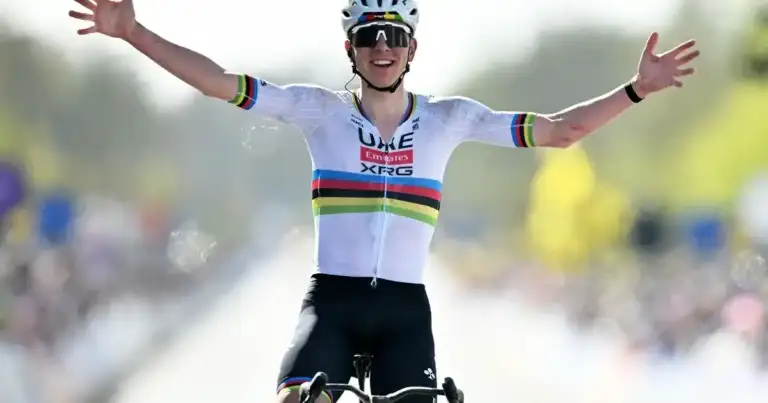
The Slovenian sensation didn’t merely participate in Flanders; he utterly conquered it, transforming one of cycling’s most brutal classics into what looked like a leisurely Sunday ride. His victory wasn’t just a win; it was a dismantling of the peloton, a masterclass in power and strategy that left his competitors trailing in his wake. This monumental achievement places him firmly alongside icons like Mathieu van der Poel, Fabian Cancellara, and Tom Boonen, an elite pantheon of cycling greats. This marks his third consecutive Flanders title, a stunning hat-trick that now ties him for the most wins ever at this revered race.
Consider this: this was only Pogačar’s third race of the 2026 season, and he boasts an impeccable 100% win rate since his return from a crash at Milan-San Remo. His solo attacks on the infamous Oude Kwaremont are fast becoming the stuff of legend, moments of pure, unadulterated power that leave commentators speechless. Even rivals are left in awe. Daan Hoole of Lidl-Trek, a man who has felt the force of Pogačar’s dominance firsthand, candidly admitted, “It’s scary how much better he is.” When a competitor offers such high praise, you know you’re witnessing something extraordinary.
The Whisper Network: Doping Shadows Return
But online, where the anonymity of the internet often emboldens the cynical, that praise quickly sours into suspicion. The digital landscape, particularly on platforms like Reddit’s r/peloton and cycling Twitter, isn’t echoing with celebration. Instead, it’s riddled with tough, uncomfortable questions. “Motor in his ass or what?” one user quipped, a crude but pointed jab. Another dismissed his domination as “copy-paste,” implying a lack of originality or, worse, something manufactured. It seems Pogačar’s seemingly flawless perfection is, for many, simply too much to digest.
Why such immediate, visceral cynicism? The answer, sadly, lies deep within cycling’s scarred history. The specter of Lance Armstrong, the pervasive EPO era, and countless other doping scandals have left indelible marks on the sport’s collective consciousness. When a rider appears utterly untouchable, when their performances seem to defy the very limits of human endurance, the immediate, almost reflexive reaction for many long-time fans is suspicion. It’s a tragic, yet understandable, reality of a sport forever grappling with its past.
“UAE’s got the good stuff again,” one comment grimly read. “Remember his ’25 surge?”
These kinds of remarks aren’t just idle chatter; they are direct echoes of past controversies, linking Pogačar, perhaps unfairly, to old ghosts. The “nice guy” persona, the charismatic smile, the seemingly genuine humility he’s known for? Online, it’s often cynically dismissed as mere PR spin, another layer of artifice designed to mask an uncomfortable truth.
The Unbearable Weight of Perfection
Let’s truly consider the situation. Pogačar is, by all accounts, a phenom. He’s young, undeniably charismatic, and he wins. A lot. But in a sport where every single watt of power is meticulously measured, where every performance is dissected under the harshest of microscopes, such absolute, unwavering dominance can feel… unnatural. It’s particularly jarring when his rivals, by their own admission, are giving “100%” and still finding themselves utterly outclassed, dusted by a rider who seems to operate on a different plane of existence.
When a respected rival like Hoole states, “Power data ‘impossible’ in headwinds,” it’s not just an observation; it’s fuel to the fire. It provides the cynics with more ammunition, more justification for their doubts. It compels them to question the very fabric of his achievements, the legitimacy of his breathtaking results. Is it fair to Pogačar? Probably not. But it is, undeniably, the harsh reality of modern professional sports, particularly one with cycling’s checkered past.
We, as fans, crave heroes. We yearn to believe in pure, unadulterated talent, in the triumph of the human spirit. But we have been burned, repeatedly and spectacularly. So, when a rider like Pogačar emerges, breaking records with astonishing regularity and making it all look so effortlessly easy, our collective trauma kicks in. We instinctively begin to search for the cracks, to poke and prod at the façade. We begin to whisper.
What Does This Mean for Cycling’s Future?
This isn’t merely about Tadej Pogačar; it’s a much larger conversation about the sport’s very image and its enduring struggle for credibility. Can cycling ever truly escape the long, dark shadow of its past? When its brightest stars shine with unparalleled brilliance, do they inadvertently cast the longest, most unsettling shadows of doubt?
The online backlash isn’t just background noise; it’s a potent symptom of a deep-seated mistrust that continues to plague the sport. It starkly illustrates that even in 2026, the specter of doping looms large, a constant, nagging presence. Pogačar is, without question, an incredible athlete, and his raw talent is undeniable. But the court of public opinion, especially in the unforgiving arena of the internet, is a brutal, often irrational place. They demand answers. They demand transparency.
His team, UAE Team Emirates, cannot afford to be complacent. They need to be proactive, to address these whispers head-on. Not with vague, corporate PR fluff, but with clear, verifiable facts, with a level of transparency that leaves no room for doubt. Because right now, Pogačar isn’t just battling other riders on the road. He’s battling history. He’s battling an entrenched culture of cynicism that threatens to diminish his every achievement.
Ultimately, this isn’t just a cycling story; it’s a profoundly human story. It’s about how we react to greatness, how we process dominance, and how, sometimes, the very best among us are met not with universal cheers, but with a chilling undercurrent of suspicion. Can Pogačar continue his winning ways and, in doing so, finally win over the skeptics? Or will his incredible, almost unbelievable performances forever be tainted by the relentless whispers of the past? That, my friends, is the real, unspoken race he’s running, and its outcome will shape the narrative of cycling for years to come.
Source: Google News