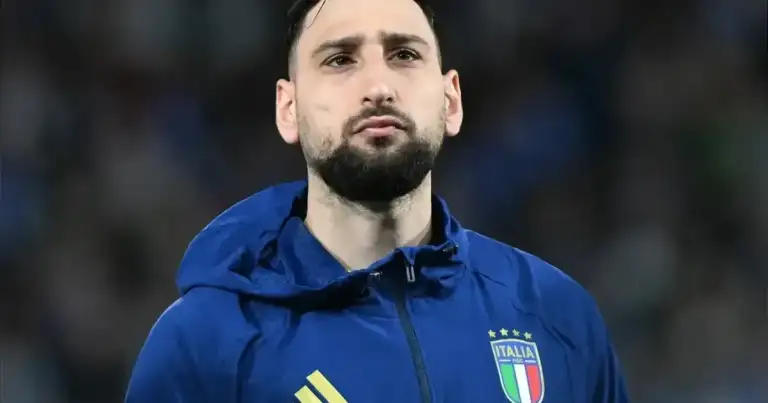

The unthinkable has happened again. Italy, a titan of international football, has cemented its legacy as a global laughingstock, missing its third consecutive World Cup. This isn’t merely a sporting misfortune; it’s a systemic, catastrophic failure that has plunged a proud footballing nation into an abyss of despair, all while Gianluigi Donnarumma inexplicably becomes the tragic face of this monumental collapse.
This latest, soul-crushing debacle unfolded on March 30, 2026, when Italy, with all its supposed pedigree, succumbed to a humiliating 1-0 defeat against North Macedonia in a playoff semi-final. The dagger, plunged deep into the heart of Italian football, came in the 92nd minute courtesy of Aleksandar Trajkovski. And who was in goal, the supposed impenetrable wall? None other than Donnarumma, the man hailed as the world’s best, beaten once more, sealing Italy’s ignominious fate.
Let that sink in: three consecutive World Cups missed. They stumbled out of contention for 2018, repeated the shame for 2022, and now, 2026. Donnarumma, a constant, agonizing presence through this trifecta of failure, was predictably on his knees, head buried in his hands, after the final whistle. A picture of abject surrender that has become sickeningly familiar.
The Donnarumma Delusion: A Legacy Forged in Failure
This isn’t about a single match, a solitary mistake. This is about a damning pattern. Donnarumma, at a supposedly prime 27 years old, is meant to be an unshakeable force, a world-class guardian of the net. Instead, he has become the undisputed poster boy for Italy’s World Cup purgatory. The narrative is clear: when the stakes are highest, Donnarumma falters.
The fans, those long-suffering devotees, are not holding back. Online, he’s “Gigio the Heartbreaker,” the subject of relentless mockery for his “third flop.” Social media is a venomous cesspool of memes and scathing critiques. “Portiere da play-off, non da Mondiale,” they scream – a goalkeeper for playoffs, not for the World Cup. They cast a cynical eye on his colossal Man City paycheck. Is he too comfortable? Has the immense wealth dulled the competitive edge vital for a nation’s hopes?
As one viral post from an Italian fan succinctly put it, “Donnarumma’s contract is bigger than Italy’s World Cup hopes. Coincidence? I think not.”
This isn’t to say Donnarumma is solely to blame, but he is the last man standing. He is the final barrier. The buck, ultimately, stops with the man between the sticks, even if the entire rotten system is collapsing around him.
Mancini’s Mirage: Euro Glory to World Cup Shame
Remember Roberto Mancini? The architect of Italy’s glorious Euro 2020 triumph? That feels like a lifetime ago, a distant, cruel mirage. Now, he’s perched precariously on the hottest of hot seats, facing an inferno of public outrage. Calls for his immediate resignation are deafening, and frankly, justified.
How does a team, fresh off European glory, disintegrate so spectacularly? Mancini’s tactical acumen is under the microscope, and the findings are damning. Against North Macedonia, Italy boasted a staggering 70% possession. They unleashed an astonishing 32 total shots, compared to North Macedonia’s paltry 4. Yet, they lost. This isn’t “bad luck”; this is a grotesque display of managerial incompetence, a failure to convert overwhelming statistical dominance into tangible results. It’s a dereliction of duty.
And let’s not forget the complicity of the Italian Football Federation (FIGC). President Gabriele Gravina is facing a barrage of criticism, and rightly so. Each missed World Cup isn’t just a blow to national pride; it’s a financial hemorrhage, costing the federation tens of millions of euros in sponsorship, broadcasting rights, and merchandising. The cumulative financial devastation over three tournaments is not merely staggering; it’s an indictment of profound mismanagement at the highest levels. This isn’t just about the beautiful game; it’s about a catastrophic financial black hole.
Systemic Decay: Beyond the Scapegoats
This crisis extends far beyond a single coach or a beleaguered goalkeeper. This is a systemic failure, a deep-seated rot within the very foundations of Italian football. Italy, a nation steeped in footballing history, boasts:
- Four World Cup titles (1934, 1938, 1982, 2006).
- Historically, they missed only one World Cup before 2018 (1958).
Now, they’ve missed three in a row. This isn’t just unprecedented; it’s the darkest, most humiliating period in the storied history of Italian football. The question isn’t “why did this happen once?”; it’s “why is this allowed to happen repeatedly?”
Is it a failure of youth development, a barren pipeline of talent? Is Serie A, once a beacon of tactical brilliance, now too weak, too reliant on foreign imports, stifling homegrown talent? These are not rhetorical questions; these are urgent inquiries that the FIGC must answer with concrete action, not platitudes. They are failing their fans, their nation, and the very future of Italian football.
The “So What” Factor: A Nation’s Soul Crushed
In Italy, football isn’t merely a sport; it’s a religion, an intrinsic part of national identity. Missing the World Cup three times isn’t just a disappointment; it’s a gaping wound in the nation’s soul. The repercussions are far-reaching, impacting:
- National morale: A collective sense of shame and disillusionment.
- Cultural celebrations: The vibrant street parties, the communal gatherings, all extinguished.
- Economic activity: Bars, restaurants, merchandise sales, tourism – all suffer significant losses.
What about the next generation? Young Italian footballers are growing up without seeing their heroes on the grandest stage. How does this absence of inspiration affect their aspirations, their drive, their very dreams? How does it impact the future talent pool, the lifeblood of the sport? The long-term damage, both tangible and intangible, is immeasurable. This isn’t just a game anymore; this is a national crisis of identity and pride.
Donnarumma himself, in a rare moment of candor, admitted, “It’s an indescribable pain. We gave everything, but it wasn’t enough. It’s a nightmare that keeps repeating.” Mancini, ever the tactician, offered, “We dominated, we created so many chances, but football can be cruel.” Gravina, the embattled president, lamented “a dark day.” These are just words, hollow echoes in the face of repeated failure. Where are the actions? Where is the accountability?
The brutal truth is that North Macedonia, a nation with a fraction of Italy’s footballing infrastructure and history, has now upset them not once, but twice on the World Cup stage. This isn’t an anomaly; it highlights a critical, terrifying reality: the gap between traditional powerhouses and smaller nations is shrinking, and Italy, once a colossus, is rapidly falling behind, clinging to past glories while the world moves on.
Will Mancini resign, or will he be unceremoniously sacked? Who possesses the courage and vision to step into this poisoned chalice? More importantly, what radical, fundamental changes will the FIGC finally implement to halt this catastrophic decline? These are not questions for tomorrow; these are demands for immediate, decisive answers. Italian football doesn’t just need a tweak; it needs a complete, brutal overhaul. A reset from top to bottom, a scorched-earth policy to rebuild from the ashes. Anything less is not just a disservice to the fans; it’s an unforgivable betrayal of a nation’s passion. This isn’t just bad luck. This is irrefutable proof of profound, institutional incompetence, broadcast to a world that is watching Italy fail, again and again.
Source: Google News