
Death stared down Wyatt Miller at Evergreen Speedway, threw him around like a rag doll, and the kid just spit in its eye. Another Earnhardt took a brutal tumble, a wreck that would have sidelined lesser men, and then drove his mangled machine back to the garage like nothing short of a minor fender bender had occurred. This wasn’t just a crash; it was a declaration.
The carnage unfolded on Wednesday, August 12, 2026, during the ARCA Menards Series West race in Monroe, Washington. Miller, piloting the No. 16 Chevrolet for Hattori Racing Enterprises, was running strong, battling for a top-10 spot, showing the kind of raw talent that makes a name, not just carries one.
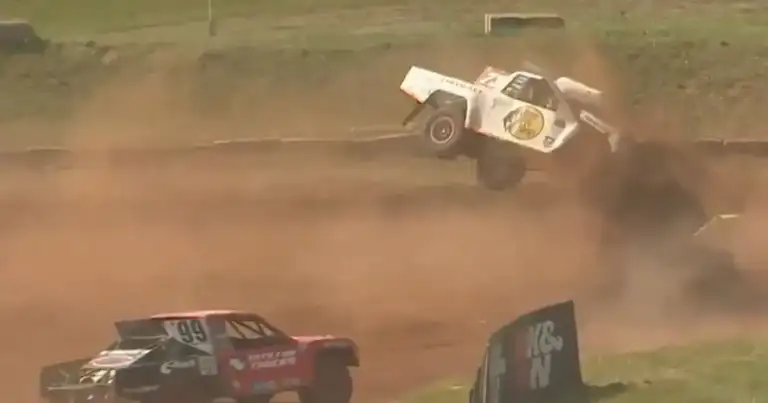
Then, on Lap 45 of the NAPA Auto Parts ARCA 150, the bottom fell out. His car slammed into the wall, a sickening crunch that echoed through the stands. The impact spun him out, a helpless projectile.
He was then T-boned by the oncoming No. 41 car of Tyler Reif. That second, pulverizing hit didn’t just send Miller’s car into a spin; it launched it into at least three full, violent flips down the front stretch.
It was a highlight reel of destruction, a moment where every fan’s heart stopped.
The Earnhardt Spirit: Unbroken, Unbowed
The entire damn crowd held its breath. You could feel the collective gasp, the dread hanging heavy in the air.
But then, as if by some divine intervention, the car landed on its wheels. Just like his legendary grandfather, Dale Earnhardt Sr., Miller didn’t wait. He didn’t hesitate.
He climbed right out of that twisted metal, a picture of defiance. Medics swarmed him at the infield care center for a routine check after such a cataclysmic event. They released him, miraculously, with no serious injuries. Not a scratch, not a limp, just pure, unadulterated adrenaline.
But the real gut-punch, the moment that solidified his place in the Earnhardt saga, came next. Miller didn’t just walk away; he got back into that pulverized No. 16 Chevrolet.
He fired up the engine, a clear indication of the sheer resilience of modern engineering and Miller’s own stubbornness. Slowly, deliberately, he drove it all the way back to the garage.
The stands didn’t just cheer; they erupted. It was a roar of approval for a young man who embodies the very essence of grit, the kind of unyielding spirit you don’t just expect from an Earnhardt—you demand it.
This wasn’t some rookie getting lucky or a fluke. This was a statement carved in bent steel and burning rubber.
An Earnhardt doesn’t just survive a wreck; he stares it down, dusts himself off, and finishes the job. Even if the car is nothing but scrap metal and a prayer, the driver refuses to be broken.
That’s the legacy. That’s the bloodline.
Modern Miracles: How Safety Cheated Death
Let’s not mince words. Two decades ago, that crash was a death sentence, plain and simple. Career over, life potentially over.
But Miller walked away clean, a clear demonstration of the relentless, often brutal, evolution of racing safety. This wasn’t luck; this was a hard-won victory for engineering and a painful lesson learned in blood.
The sport learned those lessons the hardest possible way. Dale Earnhardt Sr.’s fatal crash at Daytona in 2001 didn’t just change NASCAR; it fundamentally reshaped the entire industry.
That tragedy wasn’t just a loss; it was a catalyst, forcing the sport to get brutally serious about protecting its gladiators. They made the HANS device mandatory, a neck-saving piece of equipment that’s prevented countless catastrophic injuries.
They built the revolutionary SAFER barriers, transforming concrete walls into energy-absorbing cushions. Car chassis were completely re-engineered, seats redesigned, and roll cages fortified beyond anything imaginable in the pre-2001 era. These aren’t just upgrades; they’re lifelines.
Miller himself, still buzzing from the near-death experience, didn’t pull any punches when he spoke to reporters outside the care center.
That was definitely a wild ride. I’m just so thankful for all the safety equipment in these cars. The HANS device, the seat, the roll cage, it all did its job. It’s a shame to tear up a good car like that, but I’m walking away, and that’s what matters.
He’s absolutely right. The equipment didn’t just perform; it excelled. The roll cage held firm, a steel fortress around him.
The HANS device protected his neck from the whiplash that often proves fatal. This wasn’t some cosmic stroke of luck; this was decades of scientific advancement and a painful commitment to driver protection paying off in the most spectacular, life-saving way possible.
The Brutal Cost of Competition
While Miller is safe, sound, and ready to race again, Hattori Racing Enterprises is
Source: Google News