











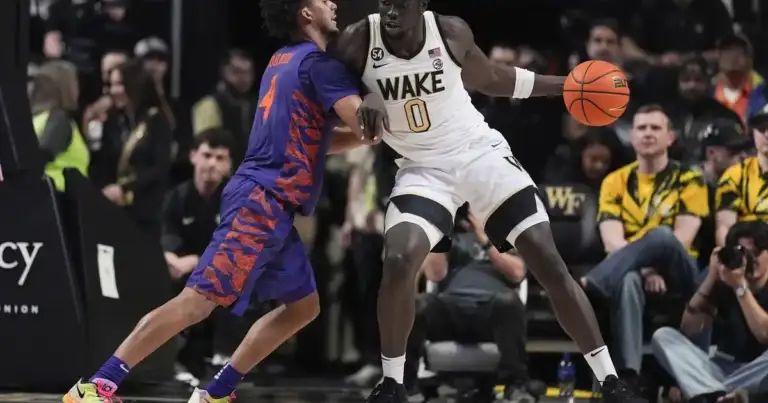

Omaha Biliew entering the transfer portal isn’t just another transaction; it’s a flashing red light, a blaring siren exposing the chaotic, often destructive, underbelly of modern college basketball. The NCAA’s transfer portal has, once again, swallowed a promising talent, leaving a trail of questions about player development, institutional loyalty, and the relentless pursuit of immediate gratification.
Biliew, a bona fide five-star prospect and McDonald’s All-American, played a mere 7.9 minutes per game for Iowa State. His stat line? A paltry 2.4 points and 1.8 rebounds. For a player of his caliber, those numbers aren’t just disappointing; they’re an indictment. They scream “underutilized” and “mismanaged,” laying bare the harsh realities of a system that often fails its most gifted young athletes.
The Five-Star Fadeout: A Systemic Failure
Biliew’s departure isn’t an isolated incident; it’s a stark reminder that high school rankings, once a reliable predictor of collegiate success, now mean less and less. The pressure for immediate impact in college basketball is astronomical. Players are no longer afforded the luxury of time to develop, to acclimate, to grow into their potential. They are expected to produce from day one, or risk being cast aside.
As the No. 30 overall recruit in his class, Biliew arrived in Ames with the weight of immense expectations. Iowa State fans envisioned a future star, a cornerstone of their program. Instead, they witnessed a bench warmer. This isn’t solely on Biliew; it’s a systemic issue, a reflection of a landscape that prioritizes quick fixes and instant gratification over patient, holistic development.
One has to wonder: how does a program, especially one with Iowa State’s reputation, fail to integrate and unleash a talent like Biliew? Was the system truly a bad fit, or did the coaching staff simply mismanage his immense potential? These are the questions that must be asked, not just of Iowa State, but of every program that sees top recruits wither on the vine.
The Portal’s Grinding Gears: Loyalty’s Demise
The transfer portal, while ostensibly offering players freedom, has become a revolving door, a relentless churn that undermines stability and long-term vision. How can teams build genuine chemistry when rosters are in constant flux? How can coaches foster deep development when they can’t rely on players sticking around for more than a single season?
This volatile environment disproportionately benefits agents and NIL collectives, who actively nudge players toward “greener pastures.” Loyalty, once a bedrock of college athletics, is now a quaint relic. In today’s landscape, money talks, and players, understandably, walk. It’s a business, plain and simple, and every move is calculated.
Now, Biliew is on the hunt for a new home, a new system, and, undoubtedly, more playing time. Every major program in the country will be lining up, eager to secure his services. The bidding war has begun, and make no mistake, it’s about more than just basketball.
NIL’s Silent Hand: The Financial Undertone
Let’s not be naive. While not explicitly stated in every transfer announcement, NIL opportunities are an undeniable, often dominant, factor. Players follow the money, and honestly, who can blame them? The NCAA, in its infinite wisdom, unleashed the NIL beast, and now it runs wild, shaping every transfer decision with a significant financial undertone. This isn’t just about athletic fit anymore; it’s a complex business transaction.
The top programs, with their deeper pockets and more lucrative donor networks, will inevitably offer the most attractive NIL packages. Biliew, like any savvy young professional, will meticulously weigh his options. His next move won’t just be about minutes or offensive schemes; it will be a strategic calculation, balancing athletic opportunity with financial gain.
Iowa State’s Black Eye: A Blow to Credibility
Losing a player of Biliew’s caliber is more than just a roster change for Iowa State; it’s a significant blow to their program’s image and recruiting credibility. They invested heavily in a top-tier recruit, and by all appearances, they failed to nurture his potential. What message does this send to future prospects considering Ames?
Why commit to a program if there’s a perceived risk of underdevelopment or underutilization? Other elite recruits are certainly taking notice, and this makes the already cutthroat world of college recruiting even more challenging for Coach T.J. Otzelberger and his staff. It undermines the program’s ability to attract and retain top talent.
Coach Otzelberger, as expected, issued the standard coach-speak statement, wishing Biliew well. But behind the polite facade, this is a significant loss, a glaring failure to develop and retain a generational talent. His words ring hollow when juxtaposed with Biliew’s minimal impact:
“We appreciate Omaha’s contributions to our program this past season and wish him well in his future endeavors. We support him in his decision and will continue to focus on building a championship-level team at Iowa State.”
Contributions? Biliew barely saw the court. This isn’t just about a player leaving; it’s about a program failing to maximize an asset, and that’s a narrative that sticks.
The Player’s Perspective: A Quest for Growth
From Biliew’s vantage point, this is a necessary reset. He was a McDonald’s All-American for a reason; his talent is undeniable. He desperately needs a fresh start, the right situation with a coach and a system that can unlock his immense potential. Not every player is poised to dominate as a freshman; some require time, patience, and a tailored approach – luxuries rarely afforded in the current college basketball climate.
The pressure on these young athletes is immense: sky-high expectations, constant scrutiny, the relentless noise of social media. It’s a pressure cooker, and many crack under the strain. Biliew is simply trying to find an environment where he can thrive, not just survive.
Where To Next? The Portal’s Perilous Promise
So, which programs will gamble on Biliew? Teams in dire need of an athletic, versatile forward with defensive upside will undoubtedly come calling. His potential is still immense, and someone will believe they can be the one to unleash it.
But will he find a truly better fit? The transfer portal, while offering opportunity, is also fraught with risk. It’s not a guaranteed path to success, and many players find themselves lost in its swirling currents. Consider the cautionary tales: Patrick Baldwin Jr., who transferred from Milwaukee to the Duke Blue Devils only to struggle there before making it to the NBA. Or Emoni Bates, who moved from Memphis to Eastern Michigan before his NBA leap. Moussa Cisse, a highly touted big man, bounced from Memphis to Oklahoma State, then to Ole Miss. The grass isn’t always greener, and sometimes, the constant movement can hinder rather than help development.
The NCAA’s Self-Inflicted Wound: A Mercenary Game
The NCAA, through its own policies, created this monster. They flung open the transfer portal, granted immediate eligibility, and then fueled the NIL frenzy. Now, they seem utterly incapable of controlling the chaos they unleashed.
College basketball has devolved into a mercenary game. Players move freely, teams are rebuilt annually, and the concept of continuity or a long-term vision is rapidly eroding. This isn’t just bad for the integrity of the sport; it alienates fans who struggle to connect with transient rosters. Team identities blur, and what was once a passionate athletic endeavor has become a cold, transactional business.
Omaha Biliew is more than just another name in the portal; he’s a symbol. He’s another casualty of a broken system, a system that prioritizes instant gratification and financial gain over player development and institutional stability. And tragically, the NCAA, the very body meant to govern and protect the sport, seems content to simply watch the chaos unfold.
Source: Google News
