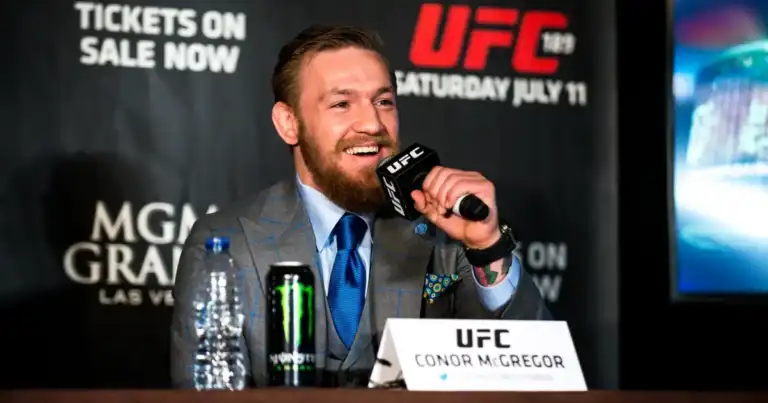

The roar of the crowd, the anticipation, the electric tension – all shattered in a brutal 63 seconds. Conor McGregor’s highly anticipated return at UFC 329 didn’t just end; it collapsed, violently and decisively, against his nemesis Max Holloway.
The catastrophic blow struck on Saturday, July 10, 2026. McGregor, mid-assault, crumpled to the canvas, clutching his right leg after launching a powerful left kick. Holloway, ever the tactician, effectively checked the strike, turning McGregor’s own power against him for an immediate, devastating outcome.
Ringside doctors immediately halted the main event, declaring a TKO victory for Max Holloway. Slow-motion replays confirmed the horrifying truth: a clear snapping motion in McGregor’s leg. Subsequent medical reports confirmed a complete fracture of both the tibia and fibula in his right leg.
Another Catastrophic Setback: The Echo of a Past Nightmare
For McGregor, this isn’t merely new territory; it’s a terrifying déjà vu. This marks his second catastrophic leg fracture in the UFC, an almost unbelievable repeat of the injury he sustained against Dustin Poirier at UFC 264 in July 2021.
Stretchered out of the octagon, McGregor immediately underwent emergency surgery. While the procedure was deemed successful, the recovery timeline is undeniably grim. Medical experts project a grueling 9-12 months of intensive rehabilitation, a sentence that could sideline him until well into 2027 – effectively wiping out another year of his prime.
McGregor’s formidable record now stands at 22 wins and 7 losses, while Holloway’s impressive tally improves to 24 wins and 7 losses. This devastating incident isn’t just a statistic; it’s a visceral, bone-shattering reminder of the unforgiving demands of professional combat sports.
In the immediate aftermath, Max Holloway, ever the class act, expressed genuine concern for McGregor. Yet, with the fight game’s relentless pace, he swiftly reaffirmed his readiness to face any challenger.
“First and foremost, I wish Conor a speedy recovery. Nobody wants to win like that. He’s a legend, and I hope he comes back stronger. But business is business, and I was ready for whatever he brought,” Holloway stated, according to ESPN.
UFC President Dana White, visibly shaken, acknowledged the gut-wrenching nature of the injury. He lauded McGregor’s unwavering dedication and wished him a swift, complete recovery.
“It’s heartbreaking to see. Conor put in the work, he was ready. This is the brutal nature of this sport. We’re all wishing him the best for his recovery. He’s a warrior, he’ll be back,” White told MMA Junkie.
The Lingering Question: Can He Ever Be the Same?
This second, devastating leg injury doesn’t just raise questions; it unleashes a torrent of doubt: Can Conor McGregor ever truly be the same fighter? What seismic implications does this carry for his career longevity, his very identity in the octagon?
The cold, hard truth of combat sports history delivers a grim prognosis: vanishingly few fighters ever reclaim their absolute peak after two severe lower-body fractures. McGregor’s entire dynamic hinges on explosive striking and fluid movement. The psychological barrier alone – learning to trust a twice-shattered limb in the heat of battle – is an immense, perhaps insurmountable, hurdle.
Age isn’t just a factor; it’s a relentless opponent. At 38 years old in 2026, McGregor’s body has already absorbed a lifetime of elite combat. Recovery times don’t just lengthen with age; they stretch into agonizing eternities, while the body’s diminishing capacity to absorb damage makes a full, explosive return to his previous form not just challenging, but a statistical anomaly.
The path ahead is not merely intense; it’s a brutal gauntlet. A complete tibia/fibula fracture demands a minimum of 9-12 months of relentless, excruciating physical therapy.
Beyond just rebuilding strength, he faces the monumental task of regaining proprioception – the subconscious trust and awareness of his limb. This grueling, all-consuming process will devour a significant, irreplaceable portion of his remaining prime fighting years.
Drive Versus Dollars: The Ultimate Test of Will
McGregor’s immense financial success outside the octagon isn’t just a blessing; it’s a double-edged sword that presents a unique, profound challenge. Unlike many fighters driven by necessity, he has achieved staggering financial independence.
While this security offers comfort, it can also subtly erode the burning hunger, the primal desperation required for truly grueling comebacks. Will the fire to endure another year of pain, sacrifice, and doubt still blaze within him?
Beyond the physical, his very fighting style is under threat. Even if McGregor defies the odds and returns, he will almost certainly be forced to adapt, to fundamentally alter his aggressive, kick-heavy style to protect his now-compromised limb.
This isn’t just a tweak; it’s a potential redefinition of his fighting identity, a change that could strip away the very essence of what made him “The Notorious.” Can you truly be “The Notorious” without the signature power and unpredictability?
Dr. Robert Johnson, a leading orthopedic surgeon, offered a stark professional assessment of such catastrophic injuries. “A compound fracture of both the tibia and fibula is not just severe; it’s a career-threatening event. It demands significant surgical intervention and a long, arduous rehabilitation period,” he explained to The Athletic.
“For an elite athlete, the monumental challenge isn’t just physical recovery, but regaining full explosive power and, critically, unwavering confidence in the limb.”
This incident brutally exposes the fragility of even the most elite athletes, a visceral reminder of the inherent, ever-present risks in intense physical pursuits. McGregor’s arduous journey through recovery won’t just be a personal battle.
It will highlight the limits of human resilience, offering a critical lesson in the absolute necessity of rigorous injury prevention and comprehensive rehabilitation, not just for champions, but for anyone pushing their physical boundaries.
The question isn’t if McGregor will fight again, but who he will be when he does. Will he once more defy the crushing weight of history and expectation, forging a new, perhaps even greater, legacy?
Or has this brutal, bone-shattering moment written the final, tragic chapter for one of MMA’s most magnetic, yet ultimately fragile, stars? The octagon awaits its answer, but the odds have never been steeper.
Source: Google News