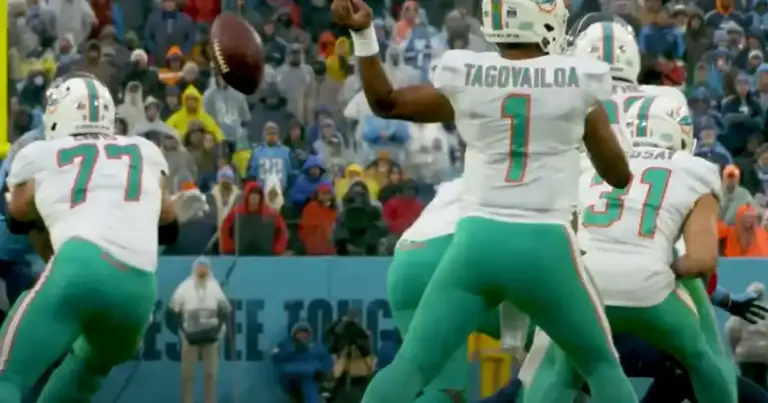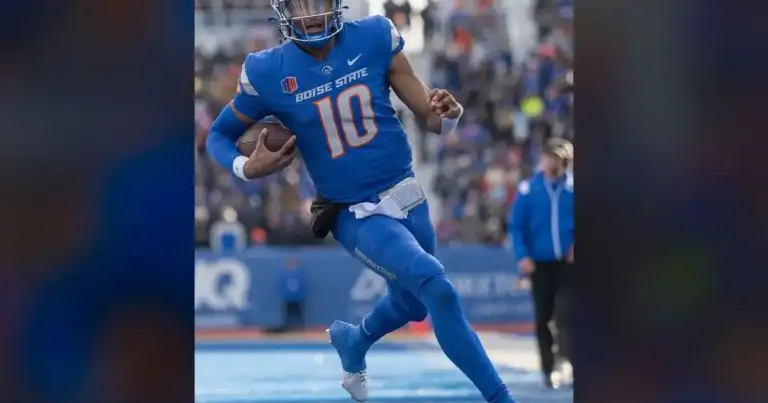

Let’s cut the pleasantries. Cleveland Browns rookie Taylen Green didn’t just “drop a bomb”; he threw down a gauntlet the size of a defensive tackle. “No one as tall as me moves like me,” he declared, and in this league, that’s not just swagger—it’s a direct challenge to every signal-caller, every scout, and every defensive coordinator who thinks they know what a quarterback should look like. The kid’s got the measurables that make grown men drool, but can he back up that audacious claim when the pads start popping and the real money is on the line?
Green, a high-stakes gamble by the Cleveland Browns in the 2026 NFL Draft, wasted precisely zero seconds stirring the pot. His bold statement, delivered during the recent rookie minicamp in early May 2026, wasn’t just a soundbite; it was a declaration of war on conventional wisdom. This isn’t about fitting in; it’s about forcing the league to adapt to him. The Browns’ front office, led by GM Andrew Berry, clearly believes in buying into that philosophy, investing significant draft capital in a player who screams “project,” but also “potential game-changer.”
The raw data on Taylen Green isn’t just eye-popping; it’s practically extraterrestrial. Standing at an imposing 6-foot-6 and tipping the scales around 225-230 lbs, he’s built like a defensive end. Yet, at the NFL Combine, he reportedly blazed a 40-yard dash in the 4.55-4.59 range.
Let that sink in: a man his size moving with that kind of velocity. He also reportedly posted a freakish 43.5-inch vertical and an 11-foot-2 broad jump. These aren’t just numbers; they’re a blueprint for a player who could redefine the position, a genuine athletic anomaly in a league obsessed with physical gifts.
Cleveland’s Quarterback Conundrum: Another Expensive Spin?
Green lands in what can only be described as a financial and positional logjam in Cleveland. The franchise remains shackled to veteran starter Deshaun Watson, whose fully guaranteed, $230 million contract is a financial albatross around the team’s neck. Also on the roster are serviceable backups Jameis Winston and Tyler Huntley.
Green’s arrival isn’t about immediate gratification; it’s a cold, calculated long-term play. It’s a massive bet on raw talent to either succeed Watson or force the team’s hand in a few years. It’s a project, yes, but more importantly, it’s an insurance policy against a multi-million-dollar mistake.
Browns GM Andrew Berry, ever the pragmatist, sees the upside, as any GM would when justifying a high draft pick. He stated,
“When you look at Taylen, you see all the physical tools you could ask for in a modern quarterback. He’s got a big arm, he’s incredibly athletic for his size, and he’s a competitor. We believe he has a very high ceiling.”
Head Coach Kevin Stefanski, always looking for new ways to scheme, echoed that sentiment, adding,
“Taylen has an incredible skillset. His size and athleticism are certainly unique. We’re excited to work with him and see how he develops within our system. He’s got a great attitude and is eager to learn.”But let’s be blunt: “high ceiling” and “eager to learn” are often code for “he’s got a long way to go.” The trenches of the NFL demand more than potential; they demand execution.
While the combine numbers are flashy, the real test is on the tape. Green’s college film from Boise State showcased a genuine dual-threat weapon. He racked up over 700 rushing yards and 10+ rushing touchdowns in his 2025 season, often bailing out broken plays with sheer athleticism. He’s a nightmare for college defenses when he tucks and runs. However, his passing accuracy and decision-making were, to put it mildly, inconsistent. That’s the real trench warfare for a young quarterback—the battle between raw talent and refined precision.
Can the “Unicorn” QB Survive the Trenches?
Green’s audacious claim about his unique movement for his height is undeniably backed by his insane athletic testing. But can he actually translate that athleticism into consistent NFL production? Or is he just another raw project destined to join the Browns’ long, ignominious line of failed quarterback experiments? This isn’t a track meet; it’s a gladiatorial arena where speed without accuracy is just a blur heading to the sideline.
The developmental timeline for Green is absolutely critical. He won’t be starting in 2026—not with Watson’s contract weighing down the cap. His immediate focus must be on mastering an NFL playbook, refining his mechanics, and learning to read defenses that are faster, smarter, and more unforgiving than anything he saw in college. The windows close in a blink. His college stats, like 2,500+ passing yards and a 60% completion rate with 18 TDs and 8 INTs in 2025, show a foundation, but also glaring areas for massive improvement. Those numbers won’t cut it in the pros; they’ll get you benched.
Accuracy concerns are not just real; they are paramount. NFL defenses feast on imprecise throws, turning potential big gains into devastating turnovers. Green needs to drastically improve his touch, anticipation, and ability to hit receivers in stride. This isn’t college anymore, where raw athleticism can cover up deficiencies. The Browns’ quarterback coach has his work cut out for him, a monumental task that will define Green’s career and potentially the future of the franchise.
Durability, Dollars, and the Franchise’s Future
A mobile quarterback, especially one of Green’s size and running style, puts his body on the line with every snap. Every scramble, every designed run, is a potential hit, a ticking time bomb for a player whose long-term value relies on his availability. The Browns coaching staff must drill into him the art of sliding and how to protect himself. Durability isn’t a luxury for a quarterback who relies on his legs; it’s a prerequisite for any long-term starter in this brutal league.
The Browns have historically struggled with quarterback stability, a dark cloud hanging over the franchise for decades. They’ve drafted plenty of high-upside guys who never panned out, becoming footnotes in a tortured saga. Green is now part of that narrative, whether he likes it or not. His success hinges not just on his talent, but on the coaching staff’s ability to polish his unique gifts while ruthlessly eliminating his weaknesses. It’s a steep climb, and the air is thin at the top.
Financially, Green’s rookie contract will be a standard four-year deal, tied to his draft slot—a bargain basement price compared to the astronomical $46 million per year monstrosity that is Deshaun Watson’s deal. This isn’t just a draft pick; it’s a strategic hedge. It’s a cold, calculated financial move by Berry to prepare for the inevitable if Watson doesn’t justify his gargantuan salary.
The investment in Green is a long-term insurance policy, a potential successor if Watson doesn’t deliver or if the team needs a more dynamic, cap-friendly option down the line. It’s smart business to have a high-ceiling prospect developing behind the high-priced starter, especially one whose contract has become a point of contention and a drag on future cap flexibility. The Browns are paying a fortune for Watson, and now they’re paying for an escape route.
Taylen Green’s confidence is palpable, almost infectious. But confidence doesn’t win games in the brutal trenches of the NFL. Performance does.
The Browns have invested in the tools to develop him, but history shows it’s a steep, unforgiving climb. Green needs to turn that raw, athletic marvel into refined, precise skill, or his bold words will just be another footnote in the Browns’ never-ending, often torturous quarterback saga.
The clock is ticking, and the NFL waits for no one. Can he truly be the unicorn, or just another ghost haunting Cleveland’s quarterback graveyard?
Photo: Staff Sgt. Joseph Morgan
Source: Google News