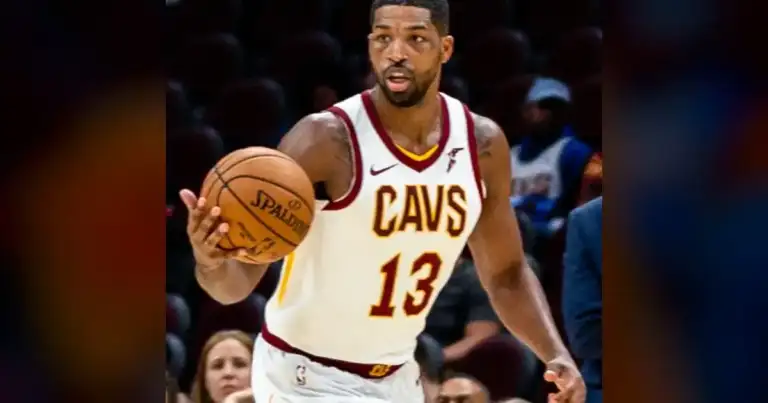

The internet, in its infinite and often infuriating wisdom, has once again proven its insatiable appetite for manufactured outrage. Tristan Thompson, an NBA star known more for his rebounding prowess and tumultuous personal life than his political acumen, is currently being dragged through the digital mud. His cardinal sin? Daring to utter a single positive word about the President, which, in today’s hypersensitive climate, is apparently enough to warrant a full-scale social media crucifixion. Never mind the nuance, never mind the context — the mob has spoken, and Thompson is their latest sacrifice.
The Los Angeles Lakers forward is facing a savage backlash after he seemingly praised the President’s economic policies, specifically an infrastructure bill, claiming it would significantly benefit his hometown. This wasn’t some grand political endorsement; it was a fleeting comment that has been twisted into a full-blown scandal, proving once again that a whisper can become a roar, especially when it suits a particular agenda.
The Fake Outrage Machine Grinds On
Thompson reportedly posted his thoughts on X/Twitter and Instagram Stories around March 29, 2026. He allegedly used phrases like “real leadership” and asserted the President was “delivering for the people.” These posts, whether genuine endorsements or misinterpreted musings, quickly went viral, igniting a firestorm that shows no signs of abating.
The internet, predictably, exploded. Fans — or perhaps, more accurately, partisan trolls masquerading as fans — hurled accusations, branding him “out of touch,” “a sellout,” and worse. Screenshots of his deleted posts still circulate like digital plague, fueling the narrative that Thompson has somehow betrayed his fanbase. Yet, in the face of this digital onslaught, Thompson has remained silent, offering neither apology nor clarification. His team, the Los Angeles Lakers, has also wisely chosen to stay out of the fray, undoubtedly recognizing the futility of engaging with a mob that thrives on unreason.
This isn’t about policy, economic impact, or even genuine concern for Thompson’s political leanings. This is pure, unadulterated political tribalism. It’s the insidious belief that athletes should only speak if their opinions align perfectly with your own. Otherwise, the tired, hypocritical mantra of “stick to sports” is trotted out. But when “their guy” gets a shout-out? Suddenly, the silence is deafening. The hypocrisy is so thick you could cut it with a knife.
What Really Happened? The Uncomfortable Truth
Here’s the inconvenient truth the outrage machine conveniently ignores: Thompson was actually at the White House on March 26, 2026, not to endorse a candidate, but to advocate for college athlete protections. This is a crucial, non-partisan issue aimed at safeguarding the futures of young athletes — a cause that transcends political divides and should, by all rights, garner universal support.
But who cares about facts when a good old-fashioned online pile-on is underway? The online mob certainly doesn’t. They saw a blurry picture — a fleeting glimpse of Thompson near White House staff — and that was all the “evidence” they needed. Instant guilt by association, a digital witch hunt fueled by assumptions and fueled by a desperate need to find fault. It’s a sign of the intellectual laziness that pervades social media discourse.
One fan on X/Twitter, clearly incandescent with rage, blasted,
“Can’t believe Tristan Thompson is endorsing [President’s Name]. So disappointed. Unfollowing.”Meanwhile, a lone voice of reason — or perhaps just a fellow traveler on the political spectrum — fired back,
“Good for Tristan for speaking his mind! Athletes have a right to their opinions too. Don’t let the haters silence you.”The battle lines are drawn, and nuance is the first casualty.
The Cheater Narrative Takes Over – A Predictable Descent
As if the political outrage wasn’t enough, the internet, ever eager to sink into the gutter, quickly pivoted. The discourse wasn’t just about politics anymore; it morphed into a full-blown character assassination. Thompson’s past cheating scandals, his well-documented personal failings, were dragged out of the archives and weaponized. “Deadbeat dad endorses deportations?” one Reddit user sneered, a grotesque leap of logic that perfectly encapsulates the internet’s capacity for malice. Another, equally unhinged, asked, “Tristan can’t keep it in his pants but wants immigrants to ‘do it the right way’?”
The narrative changed completely, from a perceived political misstep to an all-out assault on his personal integrity. His private life became the ultimate weapon, wielded by anonymous keyboard warriors with gleeful abandon. This is precisely how social media operates: it takes a tiny spark — a misinterpreted comment, a blurry photo — and ignites a raging wildfire of condemnation. In this inferno, nuance dies a swift, brutal death, replaced by a mob mentality that brooks no dissent.
Thompson, currently playing for the Los Angeles Lakers alongside superstars like LeBron James and Bronny James, is undoubtedly creating an unwanted distraction for the team. While the Lakers organization has remained silent, the shadow of this controversy inevitably looms, a sign of the far-reaching impact of online vitriol.
The Hypocrisy Is Blinding – A Selective Weapon
Let’s cast our minds back to Colin Kaepernick, shall we? He knelt for racial justice, a silent, powerful protest that cost him his career. He was blackballed, vilified, and subjected to massive condemnation. The prevailing cry? “Stick to sports!” Now, Thompson makes a perceived political move — a far less impactful one, mind you — and the very same crowd that demanded Kaepernick’s silence is either eerily quiet or, even worse, cheering Thompson on. Do you see the grotesque irony here?
This stark contrast exposes the sheer, unadulterated hypocrisy at the heart of the “stick to sports” argument. It’s not a principle; it’s a selective weapon, deployed only when an athlete’s views challenge the comfortable status quo or clash with a particular political ideology. It’s never about the purity of sports; it’s always about silencing voices they disagree with. It’s a lie, plain and simple, and anyone who still clings to it is either willfully ignorant or deeply disingenuous.
Legends like Muhammad Ali lost his title for refusing the Vietnam draft. Tommie Smith and John Carlos were expelled from the Olympics for raising their fists in a powerful statement against racial injustice. These men paid an immense personal and professional price for speaking their truth, for standing up for what they believed in. Thompson, in comparison, merely spoke about an infrastructure bill — he didn’t even make a direct political endorsement. The disparity in outrage, the selective application of the “stick to sports” rule, is not just baffling; it’s infuriating.
The Cost of Having an Opinion in the Digital Age
Thompson now faces a full-blown PR nightmare. His brand image, already somewhat tarnished by past controversies, is taking another significant hit. Sponsors, ever-sensitive to public perception, might reconsider lucrative deals. With an estimated net worth hovering around $45-50 million, the financial implications of such widespread condemnation are not insignificant. Is it truly worth it to speak your mind, even on an issue you genuinely believe in, when the backlash is so swift, so brutal, and so disproportionate?
A 2024 Pew Research Center poll revealed a telling statistic: roughly 60% of sports fans prefer athletes to steer clear of politics, while a significant 38% believe they should speak out. This inherent division within the fanbase is the kindling that fuels these infernos. Social media, with its algorithms designed to amplify outrage and create echo chambers, only exacerbates the problem. People are fed only what confirms their existing biases, and any dissenting view is immediately attacked, creating a feeding frenzy for manufactured outrage.
Why Does This Matter? Beyond Tristan Thompson
This isn’t just about Tristan Thompson. This is about the very essence of free speech, about the role of athletes as public figures, and about the insidious creep of hyper-partisanship into every facet of our lives. Should athletes be silenced, reduced to mere entertainers who are seen and not heard? Or do they, like every other human being, have a fundamental right to their opinions, even if those opinions are unpopular or challenge the prevailing narrative?
This incident is a stark, uncomfortable reminder of how politicized everything has become. Sports, once a cherished escape from the daily grind and political squabbles, are now inextricably intertwined with the political arena. It’s a pervasive seepage that makes it increasingly difficult to find refuge.
Fans, who invest emotionally and financially in their idols, often feel a profound sense of betrayal when an athlete expresses a view they dislike. It feels personal, a transgression against their loyalty. But it shouldn’t be. The actual infrastructure bill, its potential impact on communities, and the very real issues it addresses are utterly ignored in the cacophony. All that matters is the “like” or “dislike,” the validation of one’s own tribal affiliation. The mob rules, and critical thought is sacrificed on the altar of outrage.
We, as consumers of media and participants in this digital ecosystem, must ask ourselves a fundamental question: Do we truly want our athletes to be emotionless robots, devoid of thought and opinion? Or do we want them to be human beings — complex, fallible, opinionated individuals, just like us — even if those opinions occasionally differ from our own? The outrage against Thompson is not organic; it’s manufactured, driven by a toxic mix of tribalism, misinformation, and the insatiable hunger for digital drama. It’s a sad state of affairs, and we are all complicit in its perpetuation.
Source: Google News