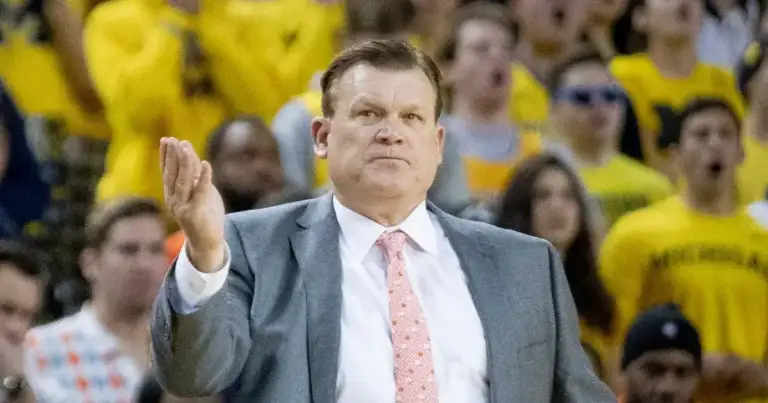

Brad Underwood declared Illinois his “dream job” after leading them to the Final Four. But the collective eye-roll from the public was almost audible. This wasn’t a heartfelt confession; it felt more like a meticulously crafted speech, delivered with the practiced ease of a seasoned politician.
The Fighting Illini didn’t just win; they crushed Iowa 71-59, securing their first Final Four berth since 2005. In the glow of that monumental victory, Underwood dropped the “dream job” bomb. Predictably, social media exploded, not with congratulations, but with a torrent of cynical takes. The consensus? This was pure, unadulterated public relations spin, designed to polish an image and perhaps set the stage for something bigger.
The Mercenary Coach: A Tale of Trophies and Transfers
The internet never forgets, and neither do college basketball fans. Underwood’s past is a well-worn roadmap of career advancement: from Oklahoma State to Oklahoma, and then, finally, to Illinois. Each stop along the way, a fatter paycheck, a more prominent stage. This isn’t speculation; it’s a pattern. And the folks on Reddit and X (formerly Twitter) weren’t shy about pointing it out.
One Reddit user, with a snarky brilliance only the internet can provide, quipped, “Underwood’s ‘dream job’ since 2017? Bro bolted from Oklahoma for Illinois, now he’s Indiana-bound rumors swirl post-F4.”
This isn’t just a random comment; it encapsulates the prevailing sentiment. It’s a stark reminder that in the high-stakes world of college sports, loyalty often takes a backseat to opportunity and, let’s be frank, cold, hard cash. This isn’t about a deep, abiding love for a particular institution; it’s about climbing the professional ladder, securing the bag, and making sure your next contract is even sweeter than the last.
Is the “Dream” Just a Performance?
The online theories are brutal, painting a picture of a coach as a calculating actor. “This is scripted Disney shit,” one post declared, cutting through the saccharine sentiment. They see Underwood not as a passionate leader, but as a performer, meticulously rehearsing his lines for the next athletic director, perhaps even preparing for a lucrative $10 million buyout exit should a truly irresistible offer come knocking.
Critics dissect his press conference demeanor with surgical precision. They point to his “snorts in pressers like a bad actor,” and his penchant for humble-bragging lines such as, “‘It’s not me, it’s the team’—yeah, and pigs fly to Final Four.” This isn’t seen as genuine humility; it’s perceived as a transparent attempt to deflect attention from his job-hopping past and present himself as a selfless leader. The public, it seems, is weary of manufactured sentiment, seeing through the “aw-shucks” routine to the calculated strategist beneath.
Why do we, as fans, crave authenticity so desperately in an era where everything feels curated? Perhaps it’s because we yearn for a connection that transcends the transactional nature of modern sports. We want to believe in the dream, but we’re constantly reminded that dreams often come with a hefty price tag.
Loyalty vs. Opportunity: The Modern Coaching Dilemma
The backlash against Underwood’s “dream job” declaration reaches its crescendo when comparisons are drawn to coaching legends. “He’s no Izzo/Krzyzewski loyalist,” one comment emphatically states, referencing coaches who built empires at a single institution over decades. These are the titans who embody unwavering commitment, whose names are synonymous with their universities. Underwood, in contrast, appears to be a pragmatist, a modern coach who follows the siren song of opportunity and financial betterment.
“Dream job until Duke calls,” is another common refrain, a pithy summary of the perceived conditional nature of his loyalty. It suggests that his commitment is fluid, beholden to the next big offer, the next prestigious program. Memes depicting him as a “grinning salesman” proliferate, implying that his ego, far from being humbled, remains firmly intact beneath the veneer of post-win modesty.
This isn’t about casting judgment on Underwood as a person; it’s about the harsh realities of big-time college sports. Coaches, much like top-tier executives in any industry, are often mercenaries. They go where the resources are richest, where the path to success is clearest, and where the compensation package is most enticing. To expect anything less in an era of multi-million dollar contracts and high-stakes recruiting battles is, perhaps, naive.
The Art of Strategic Timing: A Coach’s Calculated Move
The timing of Underwood’s “dream job” comments felt, to many, less like an organic outburst of emotion and more like a carefully orchestrated strategic maneuver. It came immediately after a colossal Elite Eight victory, a decisive rout of Houston that thrust Illinois into the national spotlight. Underwood himself, ever the astute observer, noted that fans were “louder in their city” – a classic piece of coach-speak that subtly underscores the impact and reach of his team’s success.
This was not just a moment of triumph; it was a golden opportunity. A Final Four run is a recruiting magnet, a powerful tool for attracting top talent. It also significantly inflates a coach’s market value, making him a hotter commodity for potential suitors. Was this genuine emotion pouring forth? Or was it a strategic play, a calculated move to solidify his position, enhance his brand, and perhaps, just perhaps, pave the way for an even grander future?
While some “Big Ten bros” undoubtedly celebrated Illinois’s success with unbridled joy, the cynics were quick to temper the enthusiasm. “Final Four? Yawn, Underwood’s floor is .500 tourney exits; this is portal/recruit bait,” one critic argued, cutting through the celebratory noise. They saw it as a transparent recruiting tactic, a means to attract new players and, ultimately, to build towards the next big payday, whether at Illinois or elsewhere.
Beyond the Cynicism: The Human Element in a High-Stakes Game
Let’s take a breath and step back from the relentless cynicism for a moment. Can a coach truly have a “dream job”? Absolutely. The passion, the connection to a community, the joy of building a winning program – these are real emotions that drive many in the coaching profession. However, in the current landscape of college sports, that dream is undeniably complicated. The stakes are astronomical, the money dizzying, and the pressure relentless.
For coaches like Underwood, every success, every victory, is a stepping stone. It adds another impressive line to their resume, enhances their professional standing, and increases their leverage. The fundamental question isn’t whether he enjoys his time at Illinois; it’s whether he enjoys it enough to resist the allure of a potentially better offer, a bigger challenge, or a more lucrative contract. It’s a constant negotiation between personal ambition and institutional loyalty.
Consider athletes like Washington Wizards guard Bilal Coulibaly, who averages 11.5 points per game, or Justin Champagnie, who grabs 5.5 rebounds per game. Their focus is on their numbers, their performance, their market value. Coaches, in their own way, are no different. Their numbers are wins, recruiting classes, and, ultimately, contract extensions and buyouts. It’s a business, plain and simple, albeit one cloaked in the romanticism of sport.
What’s Next for the “Dream”?
The public, it seems, isn’t buying the manufactured narrative. They see not destiny, but a coach performing for his next act. This isn’t about unwavering loyalty; it’s about strategic business decisions in a cutthroat industry.
Will Brad Underwood truly make Illinois his long-term home? Or will his “dream job” become someone else’s coveted prize in the not-too-distant future? Only time will reveal the true nature of his commitment. But don’t be surprised if that “dream” ultimately comes with a very specific, and likely very high, price tag attached. The modern coaching carousel waits for no one, not even for a dream.
Source: Google News