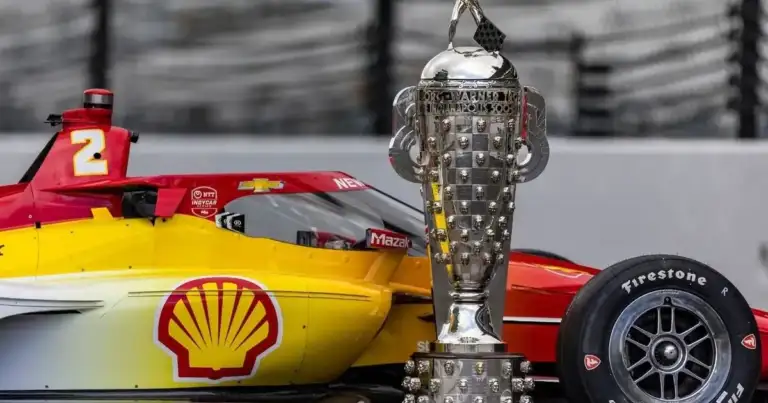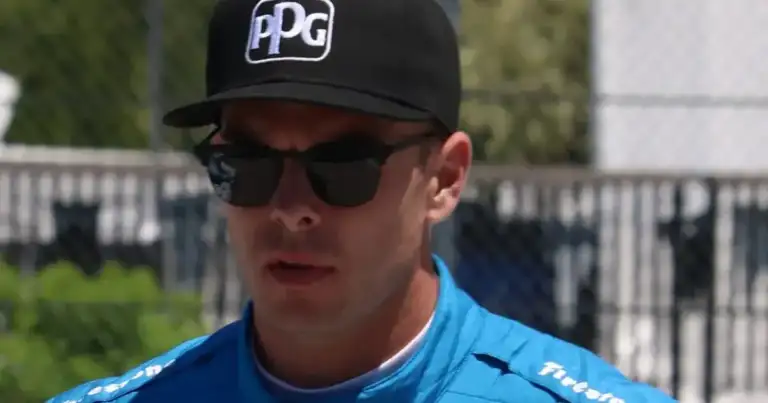

Let’s be unequivocally clear: the media’s hysterical headlines screaming about Scott McLaughlin “cheating death” after his 170mph crash at Barber Motorsports Park? That’s not just clickbait; it’s a lazy, manipulative insult to your intelligence. This wasn’t a “terrifying moment” for anyone who actually understands IndyCar. It was, quite frankly, just another Tuesday.
The incident unfolded during a routine 2026 IndyCar practice session. McLaughlin, a formidable talent driving for Team Penske, spun backwards, his car a blur of speed before it violently impacted and tore through safety barriers. The telemetry clocked his speed at roughly 170 miles per hour at the point of impact. Yet, with a shrug and a sheepish grin, he walked away, seemingly more concerned about the dent in Roger Penske’s budget than any personal injury.
The Media Hype Machine vs. The Unvarnished Truth
The headlines, predictably, shrieked “scary 170mph crash on live TV!” They breathlessly declared it a “terrifying moment” and insisted he had “cheated death.” This isn’t just irresponsible language; it’s a deliberate, calculated inflation of drama designed to prey on the uninformed. It fundamentally misleads the public about the incredible advancements in motorsport safety.
But real fans, the ones who live and breathe this sport, didn’t bat an eye. Go ahead, scour the Reddit threads or scroll through X (formerly Twitter). You won’t find trembling hands or tearful lamentations. What you’ll find are memes, sardonic jokes, and a collective eye-roll. Why the colossal disconnect? Because this, my friends, is IndyCar. This is the modern reality of elite open-wheel racing.
- Scott Dixon, a legend, crashed hard at St. Pete.
- David Malukas endured a 175mph shatter at Phoenix.
- Christian Lundgaard famously “kissed” the tire wall at Long Beach.
- Even a lesser-known driver like Kaminsky piled up at Arlington.
These aren’t isolated incidents; they’re just a few examples from this season alone. McLaughlin’s spectacular exit was part of a pattern, not an anomaly. It was a demonstration of the engineering, not a brush with the grim reaper.
The Driver’s Own Words: A Dose of Reality – McLaughlin
Even McLaughlin himself, the man at the center of this so-called “terrifying moment,” downplayed the entire affair. He told Fox Sports with characteristic candor:
“The crash looked a lot worse than it felt.”
McLaughlin openly admitted it was a “dumb grass-dab mistake,” a moment of misjudgment. His primary concern wasn’t his life flashing before his eyes, but rather the impending conversation with Penske’s accounting department about the repair bill. That, right there, is the voice of a seasoned driver who understands the inherent risks and, crucially, implicitly trusts the unparalleled safety equipment surrounding him. He wasn’t “cheating death”; he was experiencing a high-speed incident, impeccably protected by the pinnacle of automotive engineering.
IndyCar Safety: A Triumph of Engineering, Not a Tragedy Waiting to Happen
The unvarnished truth is that modern IndyCar safety isn’t just good; it’s an engineering marvel. The ubiquitous safety halo, once a controversial addition, is now undeniably a game-changer. The chassis are not merely strong; they are built like bespoke tanks, meticulously designed to dissipate energy. The tracks themselves are masterpieces of design, featuring expansive runoff areas and strategically placed barriers. These interconnected systems don’t just work; they perform miracles.
When a driver walks away from a 170mph impact, it’s not some divine intervention or a stroke of luck. It’s a direct result of decades of relentless innovation in engineering, meticulous design, and rigorous testing. It is irrefutable proof that safety measures are not just effective, but revolutionary.
The energy-absorbing barriers, often overlooked, are critical components. They are engineered to deform and break away in a controlled manner, progressively slowing the car and spreading the immense forces of impact over a longer duration. This is precisely why drivers survive what, to the untrained eye, appears to be an unsurvivable crash.
So, when the media screams “terrifying,” they aren’t just ignoring progress; they’re actively undermining it. They ignore the science, the countless hours of research, and the decades of developmental breakthroughs. They prioritize sensationalism over accuracy, all for the fleeting gratification of a click. It’s cheap, it’s disingenuous, and it’s frankly insulting to the intelligence of their audience.
Why the Public Is Over It
Fans, the true heartbeat of any sport, are utterly exhausted by this worn-out, fear-mongering narrative. They witness these spectacular crashes with increasing frequency, and crucially, they understand that the drivers are, by and large, safe. They grasp the calculated risks inherent in racing at the absolute limit of human and mechanical endurance.
These “death-defying” labels, plastered across YouTube shorts and social media feeds, are not for the initiated. They are crafted for those who don’t watch racing, for those who fundamentally misunderstand the sport’s intricate balance of speed, skill, and safety. Real fans are cynical, and rightfully so. They joked about “IndyCar safety halo saves wallet again.” They quipped that McLaughlin was “auditioning for WWE.” Some even suggested Penske was “testing fence durability ahead of Indy 500.”
This isn’t apathy. This is informed awareness. This is a recognition of the sport’s breathtaking evolution. Crashes are an undeniable, inevitable part of the spectacle. Surviving them, however, is now the expected outcome, a result of human ingenuity.
The Real “Terrifying Moments” Demand Our Attention
I’m Tamara Fellner, and at WomanEdit, we champion authentic stories. We refuse to sensationalize for clicks or traffic. We demand substance.
The real terrifying moments in women’s lives are not found within the fortified cockpit of a race car. They are found in the relentless, everyday struggles for equity. They are found in the insidious fights for equal pay, the harrowing battles against harassment, and the crushing weight of systemic inequalities that persist in every corner of our society.
When a woman, excelling in a male-dominated sport, faces unfair scrutiny or her performance is judged through a different, gendered lens, that is terrifying. When her achievements are minimized or her struggles amplified simply because of her gender, that is a moment of genuine fear and injustice.
McLaughlin’s crash was not a “terrifying moment.” It was a powerful demonstration of excellent safety standards, a profound result of brilliant engineers, and a minor, albeit expensive, setback for a driver. Let us reserve the word “terrifying” for actual, existential danger. Let’s save it for real threats to human dignity and well-being. And for heaven’s sake, let’s call out media hype for precisely what it is: cheap, manipulative, and deeply disrespectful to the intelligence of real fans. #TruthEdit
Source: Google News