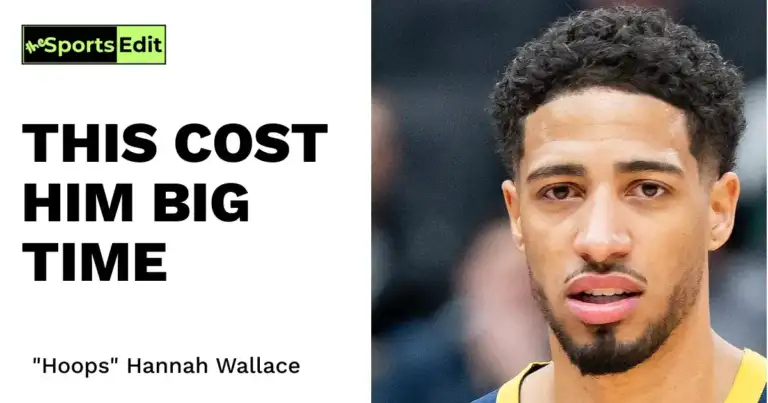

Tyrese Haliburton just poured gasoline on a raging inferno, and the internet is absolutely scorching him for it. His recent, ill-advised jab at Kentucky NBA alums has not only sparked a massive online backlash but has also cemented his status as a “clout-chasing injury ghost” in the eyes of legions of furious fans, especially after his Pacers’ Finals loss.
Haliburton took to social media to mock former Wildcats like Shai Gilgeous-Alexander and Cason Wallace. His crime? Accusing them of “switching” their allegiance to Arkansas after John Calipari’s seismic move from Lexington to Fayetteville. This wasn’t just a gentle poke; it was a direct, unapologetic shot that ignited a firestorm among Kentucky loyalists, who saw it as nothing short of a desperate grab for relevance from a player many believe is deflecting from his injury rehab and the Pacers’ playoff flop.
The post, which quickly went viral, was an immediate lightning rod. Haliburton’s smug tweet, “SGA and Cason Wallace to Arkansas is crazy lol,” was a declaration of war on an already volatile fanbase.
Haliburton’s Petty Jab Backfires Spectacularly
Haliburton’s “troll” was undoubtedly intended as a lighthearted jab, a bit of collegiate banter. Instead, it landed with the force of a meteor, obliterating any goodwill he might have had with a significant portion of the basketball world. Kentucky fans, known for their fervent loyalty and quick tempers, erupted. Social media platforms, particularly Reddit’s r/CollegeBasketball, transformed into a digital warzone, with Haliburton as the primary target.
The vitriol was immediate and brutal. One user didn’t mince words, labeling Haliburton a “clout-chasing injury ghost.” This wasn’t just a random insult; it was a direct, painful hit, referencing his significant Achilles tear and the Pacers’ ultimately disappointing playoff run. Another top thread on r/Kentucky sneered, “Bro’s alma mater finally wins a game worth tweeting, and this is his flex? Sad life.” This post alone racked up over 2,000 upvotes, a testament to the collective rage.
The backlash wasn’t limited to harsh words. Memes flooded the internet, depicting Haliburton with a noticeable limp, photoshopped into Iowa State’s victory parade with the caption, “Trolling from the trainer’s table since ’25.” Kentucky faithful didn’t just hit back; they ratioed his original post into oblivion and gleefully shared clips of Iowa State’s own ignominious first-round flameouts in past NCAA tournaments. The message was crystal clear: “You peaked at losing in ’19—stay mad.” The sheer volume and intensity of the counter-attack were a masterclass in fan-driven digital warfare, leaving Haliburton’s initial taunt looking utterly pathetic.
A Desperate Play for Relevance Amidst Injury and Playoff Disappointment?
The consensus among many critics is that Haliburton’s actions reek of desperation, a transparent attempt to cling to relevance while sidelined by injury and overshadowed by his team’s playoff exit. Is this a cry for attention from a player whose star has dimmed slightly in recent months? The evidence, unfortunately for Haliburton, points to a resounding yes.
A viral Bleacher Report reply chain didn’t pull any punches, sarcastically dubbing his social media antics “performance art” for “a guy who can’t run yet.” The connection between his injury, the Pacers’ failure to reach the Finals, and his sudden online aggression was starkly drawn. They linked the Calipari shade directly to a deflection strategy, a transparent attempt to distract from “Pacers irrelevance.” While harsh, this take resonates deeply with a fanbase hungry for genuine competition, not petty online squabbles.
Social media further amplified this narrative, coining phrases like “peak NIL-era pettiness” and accusing NBA alums of “LARPing college loyalties for engagement.” Haliburton, they claimed, was merely “the desperate.” This isn’t just about college pride; it’s about a player’s current standing, his perceived value, and whether he’s truly focused on what matters: winning on the court. When your team falls short and you’re rehabbing an injury, perhaps stirring the pot on social media isn’t the best look. It certainly doesn’t project the image of a focused, championship-driven athlete.
The Calipari Factor: A Raw Nerve for Kentucky Faithful
John Calipari’s departure from Kentucky was not just a coaching change; it was an earthquake that rattled the very foundations of college basketball. For years, Calipari built an unparalleled NBA pipeline in Lexington, churning out a seemingly endless stream of top-tier talent. His move to Arkansas didn’t just create a vacancy; it created a gaping wound in the hearts of Kentucky fans, leaving them raw and vulnerable.
Haliburton’s comments, therefore, weren’t just ill-timed; they were a cruel kick when a proud fanbase was already down. It showcased a stunning lack of awareness, an inability to read the room. Players like Shai Gilgeous-Alexander and Cason Wallace, both undisputed NBA stars, honed their craft under Calipari’s tutelage. Questioning their loyalty, especially in such a public and flippant manner, touches a deep nerve. This isn’t merely about college basketball; it underscores the profound, often familial, ties players develop with their coaches, ties that transcend university affiliations.
The Stark Irony: Haliburton’s Jab Undermines His Own Standing
Let’s cut through the noise and look at the cold, hard data. Haliburton undoubtedly had a strong individual season, earning an All-Star nod. Yet, his team, the Pacers, ultimately fell short, eliminated from contention. His injury, a significant Achilles tear, was a major contributing factor to their playoff struggles. This is a fact, not an opinion.
Meanwhile, the very Kentucky alums Haliburton attempted to diminish are not just thriving; they are dominating the NBA landscape. Shai Gilgeous-Alexander is not just an MVP candidate; he is a bona fide superstar, a statistical marvel. Cason Wallace, a rookie, has proven to be a crucial, impactful player for his team. Haliburton’s desperate attempt to diminish their success, to question their loyalty, doesn’t land. Instead, it backfires spectacularly, making him appear bitter, petty, and frankly, a bit envious. Is this truly what we expect from our NBA stars? Petty social media jabs that only serve to highlight their own team’s shortcomings? Or should they, as professionals, focus on letting their game, their performance, and their leadership do the talking? The optics here are unequivocally bad for Haliburton, tarnishing his image as a talented player with a bright future.
What Does This Mean for Player Rivalries and the Digital Age?
This incident is more than just a fleeting social media kerfuffle; it highlights a growing and concerning trend. NBA players are increasingly inserting themselves into college rivalries, leveraging their massive platforms to engage, and often antagonize, fan bases. While it undoubtedly adds a layer of drama and engagement, one must ask: is this truly good for the sport, or does it simply devolve into ugly, personal attacks?
The personal attacks against Haliburton were not just harsh; they crossed a line, extending far beyond basketball to target his injury. That is a boundary that should remain sacrosanct. Players, particularly those with such significant public profiles, need to exercise extreme caution. Their words carry immense weight. A seemingly innocuous “troll” can, as we’ve seen, ignite a firestorm, turning legions of fans against them and, worse, overshadowing their genuine on-court achievements. The digital landscape amplifies every utterance, every misstep, making discretion not just a virtue, but a necessity.
The Future of College-Pro Banter: A Cautionary Tale
This is certainly not the first time an NBA player has weighed in on college hoops, and it assuredly won’t be the last. However, the sheer intensity and personal nature of this backlash should serve as a stark warning. Fans, increasingly sophisticated and demanding, expect more from their idols than juvenile online antics. They expect professionalism, focus, and a commitment to their craft.
Haliburton’s comments were not merely ill-advised; they were a strategic blunder. They made him look small, distracted from Iowa State’s moment of triumph, and, most damagingly, opened him up to a barrage of deeply personal attacks. He needs to learn from this painful, public lesson. The next time a player feels the urge to “troll” a college program or a rival fanbase, they would be wise to think twice, perhaps even three times. In the unforgiving glare of the internet, nothing is forgotten, and sometimes, indeed, silence is not just golden, but a strategic masterstroke.
Source: Google News